Friday, February 28, 2014

A Winter Tour of the Bear River Migratory Bird Refuge, Brigham City, Utah

Refuge: n.  a condition of being safe or sheltered from pursuit, danger or trouble.

          It may seem incompatible with the above definition, but during certain seasons hunting is permitted at the Bear River Migratory Bird Refuge.  Thankfully the refuge is managed for hunters and non-hunters alike with almost 80,000 acres of habitat, and a 12 mile auto tour route.

         Bear River is accessible year-round but spring and summer can be buggy—we’re talking swarms of bugs—and fall is sometimes shared with the aforementioned hunters.  What’s a birder to do?  How about winter, when the crowds are gone and Tundra Swans congregate by the thousands at the refuge.  

         Enjoy the bird life and scenery of Bear River during winter, as captured in the following photos: 


White pelicans in flight.

A Western Grebe family.  Notice one fuzzy head peeking from the back of
the daddy grebe (top).  The other chick is trailing behind its parents.

A flock of Common Goldeneyes graces the water.

As we watched the flock, two Goldeneyes took flight.
Note the reflection of the near bird in the icy blue water.

Pie-billed Grebes navigate among the ice floes.


The honks and hoots of tens of thousands of Tundra Swans
fill the air on a winter's day.

          Ultimately, the major threat to the refuge will come not from hunters, but from a burgeoning human population in need of water.  Visit this magical place before the Bear River is diverted for residential and agricultural use.


Sunset.  The refuge and its residents are at rest and safe—for now.

March 8th is Swan Day at Bear River Migratory Bird Refuge near Brigham City, Utah.  Learn more about it by visiting their website:  http://www.fws.gov/Refuge/Bear_River_Migratory_Bird_Refuge/about.html

If you enjoy bird-watching as much as I do, you don't want to miss this:  http://www.berry.edu/eaglecam/
Bald Eagles have taken up residence on the campus of Berry College in Georgia and, last Saturday—February 22nd, 2014—a brand new eaglet was hatched!  The eagle cam provides a live, 24/7 look into the fascinating life of this eagle family.   

Tuesday, February 18, 2014

Olympic Dreams in Stowe, Vermont

        Olympic moments; they’re timeless.   So today, while you’re enjoying the games from Sochi, Russia let us journey back exactly 20 years ago, to February 18, 1994 and the Lillehammer, Norway games—inspiration for a women’s cross-country ski trip to Stowe, Vermont.  
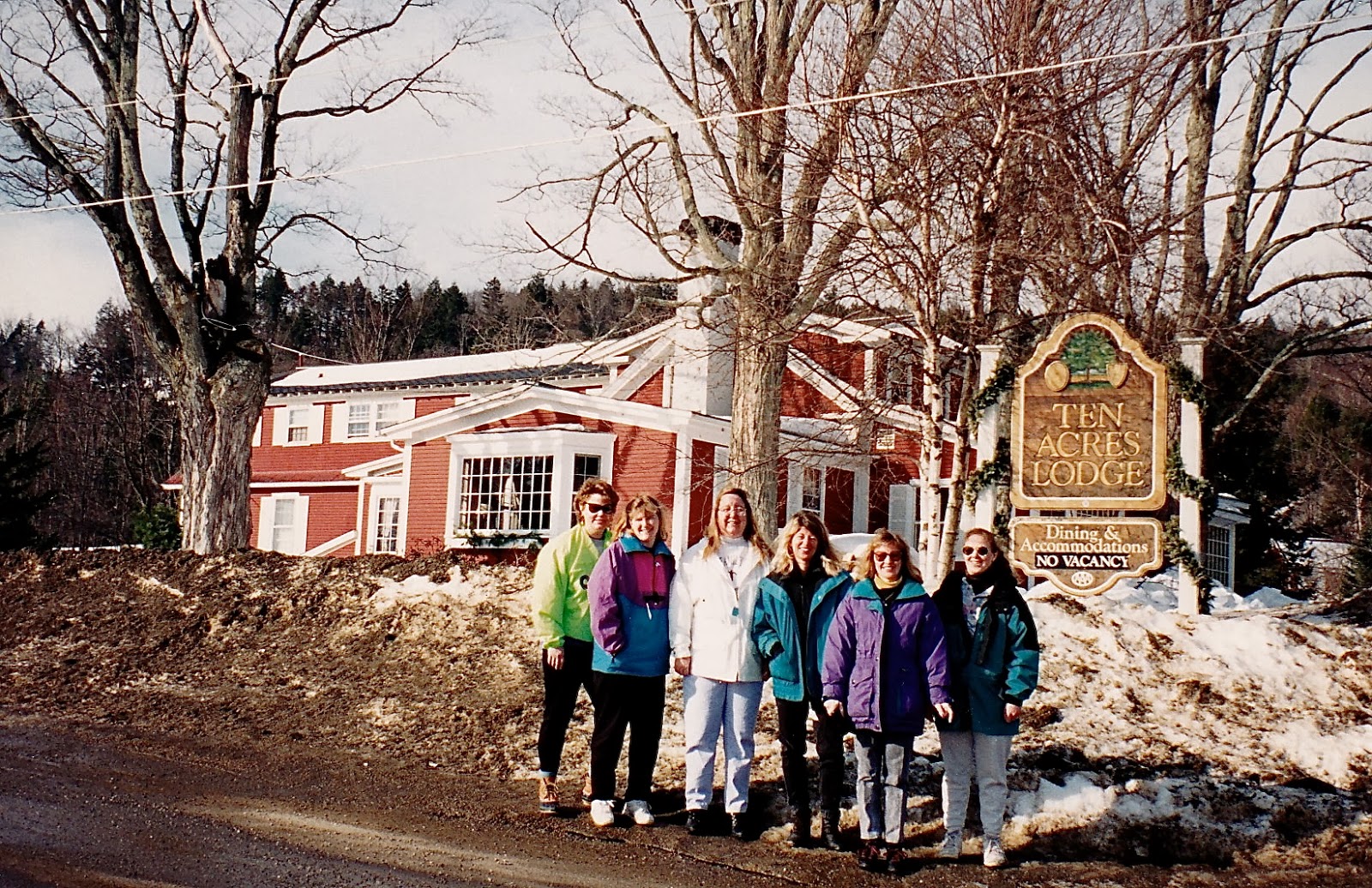
        Weary after the 10 hour drive from Pennsylvania, our adventurous group arrives at Ten Acres Lodge ready to lounge by the television and watch the XVII Winter Olympic games. 


Posing in front of Ten Acres Lodge, a classic Vermont country inn.

          American speed skater Bonnie Blair races across the ice as if jet-propelled.  Should we rent skates and give it a try?  Nah, we tried that last winter and our ankles held up for only a couple loops around the pond.  Cross-country skiing is what we came for, and watching the performance of Italian skier Manuela Di Centa— who medaled in all five nordic events—motivates the seven of us to tackle the ski trails at Trapp Family Lodge.  


Skiing part of the 100 kilometer trail network at The Trapp Family Lodge.

          The following morning we’re ready for the 2.8 mile trail to “The Cabin” at an elevation of 2100 feet.  It’s a long climb to the top, but when you arrive at The Cabin you’re rewarded with a crackling fire, homemade soup and hot chocolate—a most welcome place to take a break.
          Seasoned mountaineers are often quoted as saying that getting up the mountain is the easy part, the hard part is getting down.  Keeping that aphorism in mind we leave The Cabin to face a series of steep and winding hills.  It’s a thrilling ride down the mountain, maybe too thrilling as evidenced by my one, spectacular, cartwheeling fall.  I’m still in one piece though, and ready for another evening of relaxation in our rental cottage.


The Cabin is a popular place to chill during a day of strenuous skiing.

          For dinner we feast on homemade lasagna, then it’s time to start a blazing fire and tune in to the Olympics once again.  As we watch the skiers kick-gliding across the snow and racing effortlessly down the hills, we realize our performances today were poor imitations of these highly trained athletes.  But we’re happy with our efforts.  After all, every aspiring Olympian knows the effort is its own reward.  We turn in with dreams of, if not Olympic glory, then another memorable day on the ski trails tomorrow. 

                                                                           ****

         This weekend, after having watched the XXII Winter Olympics, dust off those skis, sharpen those blades, get out there and play on the snow and the ice.  The Winter Olympics: what better opportunity to rekindle an old passion—or to ignite a new one—for winter sports? 

         I’m happy to report that both the Ten Acres Lodge and the Trapp Family Lodge are still providing vacationers with unforgettable winter experiences.  Visit their websites for more information:  http://www.tenacreslodge.com
http://www.trappfamily.com

Sometimes it's nice to not have to traverse the snow
under your own power.  We're enjoying a horse-powered afternoon
of fun during a sleigh ride at The Trapp Family Lodge.

          Readers, do you have any Olympic moments—winter or summer—which inspired you to try a new sport?

Wednesday, February 5, 2014

Winter Adventures in Bryce Canyon National Park, Utah

         Cabin fever got you down?  Bryce Canyon National Park in southern Utah is the definitive cure for this common winter malady.  At an elevation of 8000 to 9000 feet, Bryce Canyon's rim is typically snow-covered from December to March and opportunities for winter fun abound.

Welcome to Bryce.  Tim and I arrived on January 30 and were greeted
with 50 degree temperatures and little snow.  An overnight snowfall
produced this welcoming sight on the 31st.

            If the snow is deep strap on your snowshoes to hike into the canyon and among the hoodoos—those fantastical rock formations for which Bryce is known.  Even in years of scant snowfall (this year, for instance) the Queen's Garden trail is walkable in hiking boots with good tread.  Ruby's Inn Nordic Center provides groomed cross-country ski trails near the park's northern entrance.  The trails are free and open to the public.

The layer-cake hoodoos of Bryce Canyon on a January day.

        Not the adventurous type?  You can still enjoy the scenery from Bryce's many viewpoints.  After a day spent enjoying Bryce Canyon's many offerings, I guarantee you'll never again dread the coming of our coldest season.
       Cabin fever?  Take the cure and visit Bryce Canyon now.  Doctor's orders.

       Enjoy these photos from last weekend's trip to Bryce:

                                                       Snowshoeing from Bryce Point

Our snowshoes are lined up and ready to go.

I'm peeking through the branches of a fallen Ponderosa Pine.

Dashing through the snow…  beneath Bryce Point viewpoint.


                                                                         ****

You may snowshoe from any park viewpoint, just don't venture too close to the rim—see photo below.

Looking back along the rim toward Fairview Point.


                                                                           ****

                                                  Cross-country skiing Ruby's Inn trail

Ruby's Inn's trails are groomed for both classic and skate cross-country skiing.


                                                                          ****

                                                            Queen's Garden Trail

A bench provides the perfect rest stop on the descent
into Bryce Canyon along the Queen's Garden trail.

Members of the Castle Country Canyoneers—our hiking club—on their
way to the arch (left) on the Queen's Garden trail.


To read about and view pictures from previous trips to Bryce Canyon National Park, visit this blog post:  http://onedayinamerica.blogspot.com/2012/02/snowshoeing-in-bryce-canyon-national.html


Thursday, January 23, 2014

The Wedge Overlook Recreation Area in the San Rafael Swell Desert, Utah

        Followers of this blog know of my love for outdoor activities, so it may seem strange to read that I live within an hour's drive of 2000 square miles of public land but don't recreate there often.

        What is it about the San Rafael Swell that keeps me away?  For one thing, most of the time I drive right on by while venturing to the more well-known national parks of southeastern Utah.  And, "Tom's Canyoneering Guide" describes The Swell as: "Rugged, desolate, dry, hot, wild. This is the kind of area that has little appeal to those who are not charmed by the desert. Oases of human-friendly environments are few and far between.  One of those corners of the world lost to civilization…"

The endless canyons of the San Rafael Swell.
The ribbon of white at the bottom of the canyon is the iced-over
San Rafael River.

        It's true that much of the area is either steep-walled canyon or open, inhospitable desert.  And summer can be brutally hot or buggy.  January, however, proved an ideal month to hike this arid environment.
        On an unseasonably warm winter morning Tim, our dog Annie and I arrive at the Wedge Overlook in the San Rafael Swell to hike the rim trail.  The trail is 17 miles long and open only to mountain bikers, hikers and horseback riders.  On this cloudless day our view from the canyon's rim stretches from horizon to horizon.  When Annie ventures onto the rocks at rim's edge I call her back from the 1000 foot drop-off.

It may not look like it, but there's a 1000 foot drop-off
several feet behind us!

The rim trail veers away from the river canyon.
Tim and Annie pose along one of the side canyons to the San Rafael River.

        After hiking a couple of miles we turn to retrace our steps on this out-and-back trail.  We've enjoyed solitude on today's trek, but halfway back to the trailhead Annie goes on alert.  Something has her attention.  We hear voices and try to call our dog back but she rushes off and returns, leading fellow hikers who turn out to be friends from our hiking club—The Castle Country Canyoneers.   Pete and Kathryn have also brought their dog—and Annie's best friend—Lucinda, along.  We laugh at the coincidence of this unplanned meeting, literally in the middle of nowhere, and extend our hike another mile or so, giving the dogs plenty of time to frolic in patches of snow dotting the trailside.

        After the hike we drive to a secluded spot on the rim for our picnic lunch.  Fourteen years ago, on our first trip to The Wedge, we camped along the overlook drive.  The rim is now closed to camping due to human-caused damage; a designated campground is situated in the pinions and junipers, about a half mile from the rim.

Many areas of the San Rafael Swell have been abused by illegal use
of off-road vehicles.  This large Pinion Pine—in an area closed to
motorized use—is evidence of a healthy desert environment.

Lunch on the edge.  Tim relaxes with a sandwich on a
blue-sky January day.

      This corner of the world that's been "lost to civilization" is 20 miles from where I now make my home.  And after this successful January trek in the San Rafael Swell, I'll try to remember not to overlook the 1,280,000 acres of public land in my backyard.

      To learn more about Utah's San Rafael Desert, visit this website: http://www.blm.gov/ut/st/en/fo/price/recreation/SanRafaelDesert.html
   
      You may read of four more adventures in The San Rafael Swell by visiting these previous blog posts:
      Llama trekking in the San Rafael Swell
      Annie's First Desert Hike
      Wildflowers of Horsethief Canyon
      Little Wildhorse Canyon
      Little Wildhorse Canyon is located just inside the boundary of the San Rafael Swell Desert,  near Goblin Valley State Park.  For a fantastic experience, combine this hike with a stay at the park.

Map of the San Rafael Swell Desert,
courtesy of Weber State University and Emery Maps.

Monday, January 13, 2014

Rough Air

                            
               "Come fly with me, let's fly, let's fly away…"
                                                                                      --- from the song "Let's Fly Away"
                                                                                           lyrics by Sammy Cahn
                                                                                           performed by Frank Sinatra, 1957

             The words and melody sound so inviting when Frank sings them, don't they?  But it's 2014, not 1957, and the romance of air travel has gone the way of bobby socks and the Rat Pack.

             Sunday, December 19, 2010
           
             After an idyllic vacation on the Oregon coast Tim and I are in the Eugene airport, waiting to board our flight to Salt Lake City, UT.  The gate agent announced a minor delay due to maintenance problems.  But within half an hour we boarded the plane.  Shortly after takeoff the captain assured us of a quick, smooth flight to Salt Lake City and a near on-time arrival of 3:50 p.m.  We looked forward to seeing our cats, turning on the holiday lights, listening to Christmas CDs and relaxing—a quiet Sunday evening at home.
             Two minutes after the captain's message the commuter jet slowed, turned and began a descent.  I tugged on Tim's sleeve and said:
           "This should never happen on take-off."
             Another minute and another message from the captain.
            "Folks—from the flight deck—you may have noticed that we're descending.  A warning light has alerted the crew to a mechanical failure in the plane's deicing system."
              Back to Eugene we go.  With the airport in sight the wheels rumbled down into their locked, landing position.
              "Mommy!  We're crashing!", said a six-year-old seated behind us.  Reassuring.
               We landed (without incident), then off-loaded and waited.  A short while later another announcement from the gate:
              "Due to the de-icing system failure our jet is not safe to fly.  Please get in line to be reassigned to another flight."
             
               Tim entered the long line while I phoned Delta.  I reached an agent who told me there was a single seat on a Horizon flight leaving in an hour for Portland; from Portland a flight leaves for Salt Lake at 6:15 and will arrive at 9:00 p.m.  Tim must be on that flight; he has a full day of surgeries scheduled for tomorrow.  The agent gave me a confirmation number for Tim, then put me on a flight leaving Eugene in the morning.  Tim left for the Horizon gate and I got back in line to get my ticket and make arrangements for our luggage and for my overnight stay in Eugene.  Almost an hour later I approached the counter as Tim rushed to my side.  Horizon Airlines won't take his confirmation number, they need an actual ticket from the Delta agent.
               "Oh," the Delta agent said to me, "As it happens there are many empty seats on that flight to Portland.  Would you like to be assigned to that flight?"
                Yes, I would.  I grabbed my ticket, hurried to the Horizon gate with Tim, was the last person to board the flight and... the plane was only half-full of passengers.  Shouldn't the Delta agent I spoke with on the phone an hour ago have known that?  Well, anyway, we had a smooth 20 minute flight to Portland and were a couple hours early for our 6:15 flight to Salt Lake.  We checked the departure board and, what's this?  Our flight to Salt Lake has been delayed until 9:15.  Now we had time for a sit-down dinner where we could at least use the measly $6.00 voucher issued to us by a Delta representative.

Catching some shut eye while waiting—and waiting—for the
flight home.
             
                Back at the gate we read that the flight was now delayed until 10:00 p.m.
               "What's the problem?"  I asked the gate agent.
               "Well," she said. "The plane is still in Salt Lake and hasn't taken off due to a mechanical problem with refueling."  Delta had used the same excuse for our delayed flight from Salt Lake City to Eugene earlier in the week.
                 Oh really?  Here's the thing:  I just read that Delta raked in almost 1 billion dollars in revenue from baggage fees last year.  Shouldn't Delta take some of that one billion in cash and maintain their planes?  Or maybe they could hand out meal vouchers worth more than six dollars.

                 Finally, at 10:15 p.m., we took off for Salt Lake.  The flight was smooth until the descent into the Salt Lake Valley.  A mighty wind took hold of our small jet, tossing us up and down and side to side.  With queasy stomachs we stumbled to baggage claim, only to find our luggage hadn't made the trip.  Time to stand in line again.  We handed our claim checks to the clerk.
               "Your luggage is still on the plane in Eugene and I have no idea when it will arrive.  Fill out your name and address and we'll put it on a FedEx truck for delivery when it gets to Salt Lake."
                We were home by 3:45 a.m., a full 12 hours after we had expected to arrive in Salt Lake City.

                Wednesday, December 22, 2010
             
                Steady rain all day and still no sign of my luggage.  But when I opened the side door this morning Tim's bag was on the side porch, soaking wet.  FedEx must have dropped it off last night and forgot to ring the doorbell.  I emptied the bag of its sopping contents and hung the clothing to dry.  This afternoon my bag showed up on our doorstep as well, with a San Francisco baggage tag.  I hope my bag had a nice layover in the city by the bay.

                 Our Oregon coast vacation was delightful.  The return trip, not so much.  Oh, I'll continue to fly; it's still the best way to get quickly from here to there.  But the skies are many times less-than-friendly, and jet-setting is not what was in Frank Sinatra's day.
                 Readers, do you have a nightmare flight story?
               
                Wishing everyone safe, happy, and on-time arrivals in 2014!
               

Wednesday, December 18, 2013

Snowshoeing near Lake City, Colorado

                          Season's Greetings from One Day in America!
          Snowshoeing is one of my favorite outdoor activities and the mountains of southwestern Colorado provide a perfect venue for this winter sport.
          The photos below tell the story of two recent treks in the San Juan Mountains.

Our dog, Annie, leads the way on a trail through the
snowy spruce forest.

Reaching the rim.

Annie and I pose on a rocky outcrop with a killer view.
Annie doesn't appreciate the view but she loves
playing in the snow.


Zoomed view from the above photo.  Two of Colorado's 14,000 ft.
peaks dominate the skyline:  Uncompahgre (14308') on the right and
Wetterhorn (14016') to the left.

For more information on winter fun in and around Lake City, Colorado visit this website: http://www.lakecity.com/index.php/things-to-do/winter-in-lake-city


Another day of winter adventure dawns in the Colorado mountains.


Monday, November 11, 2013

Hawk Mountain Sanctuary, Kempton, Pennsylvania


                      "The time to protect a species is while it's still common."
                                                                                                 --Rosalie Edge
                                                                                          
Hawk Mountain is located under the Atlantic Flyway, a
principal route for migrating birds.

         “Eagle, high over Five. Sharpy coming in over Owl’s Head.” 
          Dozens of pairs of binoculars rise, their owners heeding the command to scan the skies over the above-named ridges.  The directive sounds like code for incoming missiles, but the raptors filling the sky today are not military but avian—a majestic Golden Eagle and a sleek Sharp-shinned Hawk.  


Birders search the skies above ridge "Five", hoping
to catch a glimpse of an Eagle.


The view from North Lookout.

          I’m part of the crowd seated on the rocks of North Lookout at Hawk Mountain Sanctuary in Kempton, Pennsylvania.  We gaze skyward at the soaring birds, the tranquility of this moment belying the carnage which occurred here 80 to 100 years ago.  During the first decades of the 20th century thousands of migrating hawks, eagles and falcons were gunned down—injured and killed for fun by so-called “sportsmen”.  Horrified by reports of the wanton slaughter, New York socialite Rosalie Edge leased these woodlands in 1934 and stationed wardens in the area.  Ms. Edge invited the public to visit and to bird-watch; four years later Hawk Mountain became the world’s first refuge for birds of prey. 


Hunters in the early 1900s traveled to the mountain
along old horse-and-wagon trails.
This ledge is only 100 yards from the roadway, providing a
veritable shooting gallery for the hawk slaughter.
          Before leaving our rocky perch to hike the 1.1 mile trail back to the Visitor Center one more directive is issued from the Hawk Mountain intern staffing the lookout today:  “Incoming, directly overhead.”  It’s a Merlin, dive-bombing the owl statue standing guard over the spectators at North Lookout.
         Today it’s birds—not bullets—flying overhead, and the only shots being taken are photographs.  Thanks to Rosalie Edge the rolling ridges surrounding Hawk Mountain Sanctuary remain a safe haven—for both humans and raptors.


A spotting scope is trained on peaks "One" through "Five".

           Hawk Mountain Sanctuary is located in southeast-central Pennsylvania, near the Appalachian Trail.  Every day during the fall migration a staff member is stationed on the lookout to conduct an official bird count and to help visitors with raptor identification.  
          Crowds can be prohibitive on weekends during fall color season (most of the month of October).  November is my favorite month to visit the North Lookout.

Learn more about Hawk Mountain by visiting their website:  http://hawkmountain.org


Two tales of one trail.  The top photo was taken on the North Lookout
trail in September of 2013.  The bottom picture was taken on the
same trail in November of 2008.  If you're dressed for
the weather, November offers great views and no crowds.
(Bring along a thermos of hot chocolate.)