Saturday, August 27, 2011

Final Day in Swan Lake Cabin on Alaska's Kenai Peninsula

You may live in a place for months, even years, and it does not touch you, but a weekend or a night in another, and you feel as if your whole being has been sprayed with an equivalent of a cosmic wind. 
                                            Doris Lessing —  Under My Skin (1994)
Tim rises at 6:00 a.m. to start a fire in the wood stove and the cabin is warm and toasty by seven.  We feast on a delicious breakfast of Jalapeno-Cheese flat bread, pan-fried bacon and an omelet with potato, cheese and onion.
After breakfast we wander to the lakeshore and meet the woman from the campsite next door.  She and her brother had set up camp near our cabin last night; they are on a five-day backpacking trip along Resurrection Pass Trail.  Our Swan Lake “neighbor” lives in Anchorage but her family (and visiting brother) are from Washington, D.C.  The woman and her husband own a floatplane and fly the Alaskan wilderness.  She loves flying and she loves living in Alaska.
A moment of panic engulfed the woman and her brother this morning when they felt the ground shaking beneath their tent.  They yelled to each other: “It’s an earthquake!”  No, it was only a moose thundering by within a few feet of the tent’s door.


Regal Air floatplane taxis to our beach.


         By mid-morning Tim is carrying our gear to the rowboat to prepare for the floatplane’s arrival.  When you’re deep in the Alaskan wilderness there is no sound more reassuring than the distant drone of a plane on its way to collect you on the prearranged pick-up date.  We first hear, and then see, the dark blue Regal Air floatplane circling Swan Lake; the plane lands, skimming and bumping over the lake’s surface until it arrives near our beach. 


Ferrying our gear to the plane in the cabin's trusty rowboat.


          Soon we’re taxiing from the east end of the lake and lifting off into a crystal clear morning sky.  The 25 minute flight back to Anchorage is effortless and trouble-free.  We enjoy a smooth landing on Hood Lake Seaplane Base near Anchorage International Airport. Regal Air calls us a cab and we’re on our way. We chow down on pizza at the wonderful Moose’s Tooth Restaurant and Pub in downtown Anchorage.
After lunch we check in at the Courtyard Marriott, take much needed showers and luxuriate in the comfort of our hotel.  And the Courtyard Marriott is a wonderful hotel.  It’s plush.  It’s well-appointed.  But still... a stay here does not compare with the cosmic grandeur of three days spent in Swan Lake cabin.  
For information on Alaska’s Forest Service cabins re-visit my August 11, 2011 blog post: "Day One at Swan Lake Cabin on Alaska's Kenai Peninsula"


Regal Air can be contacted at this site:   http://www.regal-air.com/


Planning your own trip to the Kenai Peninsula?   Visit this website:  http://www.kenaipeninsula.org/


Goodbye and Farewell, Swan Lake Cabin.


Ready to load our gear into the "Titanic".

Saturday, August 20, 2011

Another Day at Swan Lake Cabin

         It’s a chilly morning at Swan Lake Cabin and a fire crackles in the wood stove.  
An eagle soars overhead while a mother moose and her calf bound across the yard and disappear into the trees.  Now this is the way to begin a day.
After breakfast we load our day packs with lunch, cameras, and fishing gear for a hike on Resurrection Pass Trail.  Warming temperatures and sunny skies provide excellent hiking weather.  We fight our way through alder and heavy brush on the first mile of the trail but after climbing 1000 feet the trail breaks into the open, revealing expansive views of Swan Lake and Juneau Lake.

View of Swan Lake from Resurrection Pass Trail.
          We hike another two miles and cross Swan Creek where Tim tackles the stream-side vegetation to try a few casts.  He catches several small Dolly Varden trout and then we continue along the trail until we are above tree line.  We enjoy lunch here in our own private alpine cafe.
Lunch in the Alpine Cafe.

            From our perch high on the hillside we can see beaver ponds along the stream and after lunch Tim checks the ponds for fish.  He doesn’t spot any fish but does see plenty of baby shorebirds; an angry mother gull swoops in on Tim, warning him away from her babies.

Tim fishes the beaver ponds by Swan Creek.
Yes, he's really there—can you see the tiny tan dot to the left of the lower pond?

          We return to the cabin in late afternoon and Tim decides to fish Swan Lake.  He reappears an hour later with tonight's dinner—a fresh caught rainbow trout.  We cook the trout over charcoal in our fire ring—it’s moist and delicious. During dinner a backpacking couple walks by and sets up camp along the lake's northern shore, about 50 yards from our cabin.
After dinner we launch the rowboat on still water, the mountains and spruce trees reflecting in the lake’s glassy surface.  At  11:00 p.m. a pair of loons fly in and land on the lake, electrifying the night air with their haunting calls.  
         Back in the cabin we crawl into our sleeping bags, the babbling brook outside our window lulling us into a peaceful sleep.  Now this is the way to end a day.
If you have never heard the call of a loon in the wild, you’re missing out on one of the great things about being alive.
To hear the mystical call of the loon, go to this Youtube video: http://www.youtube.com/watch?v=kiXjCifQn0w&feature=related

To read about our first day at Swan Lake go to:  http://onedayinamerica.blogspot.com/2011/08/day-one-at-swan-lake-cabin-in-alaskas.html

To read about of final day at Swan Lake go to:  http://onedayinamerica.blogspot.com/2011/08/final-day-in-swan-lake-cabin-on-alaskas.html 

Evening fishing on Swan Lake.


11:00 p.m. campfire in our front yard.


Thursday, August 11, 2011

Day One at Swan Lake Cabin in Alaska's Kenai Peninsula

One ax and one broom; one centrally located wood stove; one newly constructed outhouse; four wooden slabs for beds; hundreds of dead flies littering the kitchen counter.  Swan Lake Cabin is a gem—and it’s our home, hearth and haven for the next three days.

Swan Lake Cabin
          Minutes ago we watched our Regal Air float plane depart from Swan Lake.  It turned and disappeared over the mountains while we towed our gear to shore in the cabin’s rowboat.
We settle in at the rustic cabin.  I dispose of the flies and clean the kitchen counter while Tim unpacks our three duffel bags full of clothes, sleeping bags, pads, food, coleman stove, fuel, and fishing equipment.   
 
After dinner, images from Willa Cather’s “O Pioneers”  float through my mind as Tim chops wood while I wash dishes in a tub on the front porch steps.
Evening chores completed, it’s time to grab the oars and take the rowboat out for a spin.  We’re in the middle of a giant snow globe—the lake sparkles like a bejeweled necklace in evening’s low light; fluffy white cottonwood seeds fill the air.  We watch beavers swim around the lake, branches from newly fallen trees clutched in their jaws.  One large male swimming in front of us suddenly smacks his tail—hard—on the water, advising us to back off; we're getting too close to his lodge.  
        We see families of ducks journeying across the lake and notice terns fishing for their evening meals.  A female moose enters the water from the northern shore, swims to the middle of the lake, then browses and bathes for 40 minutes, oblivious to her human audience.  As we watch the moose Tim catches a nice rainbow trout.
At 10:30 p.m. we row back to shore, then start a fire in the cabin’s outdoor fire pit.  As we sit by the campfire the sky turn shades of orange and pink.  Another moose enters the water and strides across the lake, her tiny calf swimming alongside her.
Blue/black twilight envelopes us.  It’s almost midnight here on the 4th of July.  We may not have witnessed a fireworks display tonight, but we've had front row seats to a spectacle far greater—the splendid scenery and abundant wildlife of our 49th state. 

Read about our next two days at Swan Lake Cabin:  
http://onedayinamerica.blogspot.com/2011/08/another-day-at-swan-lake-cabin.html
http://onedayinamerica.blogspot.com/2011/08/final-day-in-swan-lake-cabin-on-alaskas.html

 
Swan Lake Cabin, nestled at the East end of Swan Lake among 2000-3000 ft. mountains, is located in the Chugach National Forest on Alaska’s Kenai Peninsula.
        State and federal agencies in Alaska offer 200 backcountry cabins for rent.  You can read all about it at:  http://www.alaskacenters.gov/cabins.cfm
         Regal Air provides charter flights, flightseeing trips, and day trips and tours to Alaska's backcountry.  Find out more by visiting this website:   http://www.regal-air.com/


The cabin's ax comes in handy.


Front yard and view of Swan Lake from the cabin.

Cooking dinner in the cozy cabin.


Thursday, August 4, 2011

Summer Fun in Ocean City, New Jersey


Giant Ferris Wheel on Wonderland Pier at Sunset.  The Boardwalk Journal, a travel magazine for the Jersey Shore, found this photo on this blog post and made it their cover photo for July, 2012.


The shore is about memory.  The shore is about family tradition.  
It is a submerged longing for innocence and simplicity,
for how we once were.  And so we go again and again 
            to places like Ocean City, Asbury Park and Cape May.                                                      Places where we don’t have to grow up.  
Places where we can grow down.
---- National Geographic, August 2004 
I live in the west and when on vacation I crave wilderness and solitude.  So why do I travel over 2000 miles to Ocean City, New Jersey every summer to experience the beach and boardwalk with 150,000 other sun seekers?   For one thing, I can spend time with my parents, two sisters and a brother-in-law.  But especially, over the years, I’ve returned to Ocean City to be with nephews Mark, Bob and Paul—reliving, through their eyes, my own childhood memories of fun and frolic at the Jersey Shore.
The Atlantic ocean provides the backdrop; its steady rhythmic surf muffles screams from roller coaster riders on Wonderland Pier, and absorbs the din of swashbuckler and reggae music blasting from mini-golf courses.
August in Ocean City is a feast for the senses:  the buttery-caramel-vanilla scent wafting from Johnson’s popcorn and Shriver’s salt water taffy; the smooth “ping” of discs gliding over the shuffleboard court; the kaleidoscope view of beach umbrellas;  the clanging bells of bicycles and surreys; the pulsating lights on the giant ferris wheel at night.
Ocean City, NJ has been called America’s greatest family resort.  It’s a place where generations come together to celebrate summer, to experience life.


Interested in creating your own family memories in Ocean City?  Check it out here:  http://www.oceancitychamber.com/

To discover the Jersey Shore’s other beach towns visit this website:  http://www.newjerseyshore.com/

Umbrellas color the beach on a blue-sky day.


Bicycling the boardwalk.

Bob is buried at the beach!

Three generations enjoy bicycle and surrey riding 
at the shore.

Early evening on Ocean City's boardwalk.

The shuffleboard tournament has begun!
(Photo by Paul Lowrie)

Paul, Bob and Mark—ready to cruise the boardwalk.
Mark and friends enjoy the Atlantic surf.
Beach Volleyball near Wonderland Pier.
The sun sets on another day of fun in Ocean City.
Jumping for Joy!


Wednesday, July 27, 2011

Swept Away in Henson Creek

mir•a•cle  >n.  a highly improbable or extraordinary event, development or accomplishment that brings very welcome consequences.
The New Oxford American Dictionary
  Henson Creek—normally a placid, slow moving river during the month of June—became a raging torrent this year due to heavy mountain snowfall and delayed runoff.
  On a Sunday afternoon in late June Tim and I drove the dirt road along Henson Creek near Lake City, Colorado.  Heading downriver toward town we saw several cars alongside the road.  I scanned the hillside across the creek and noticed five Rocky Mountain Bighorn Sheep—four ewes and one little lamb—walking wearily up the hill.

We stopped the car and got out to view and photograph the sheep.  A couple from Kansas walked toward us with their cameras and recounted a harrowing tale:  
          Earlier, as they drove upriver, they watched four ewes and five baby bighorn sheep bound from the rocks, cross the road, then try to swim across roiling Henson Creek.  All four ewes and one baby made it across but the other four lambs were swept downriver.
The woman from Kansas showed us the picture she took with her digital camera and it was horrifying—four tiny heads bobbing in the raging flow.  (How I wish I had asked her to email me that picture.)  That was 15 minutes ago, she said, and she hadn’t seen them since...  
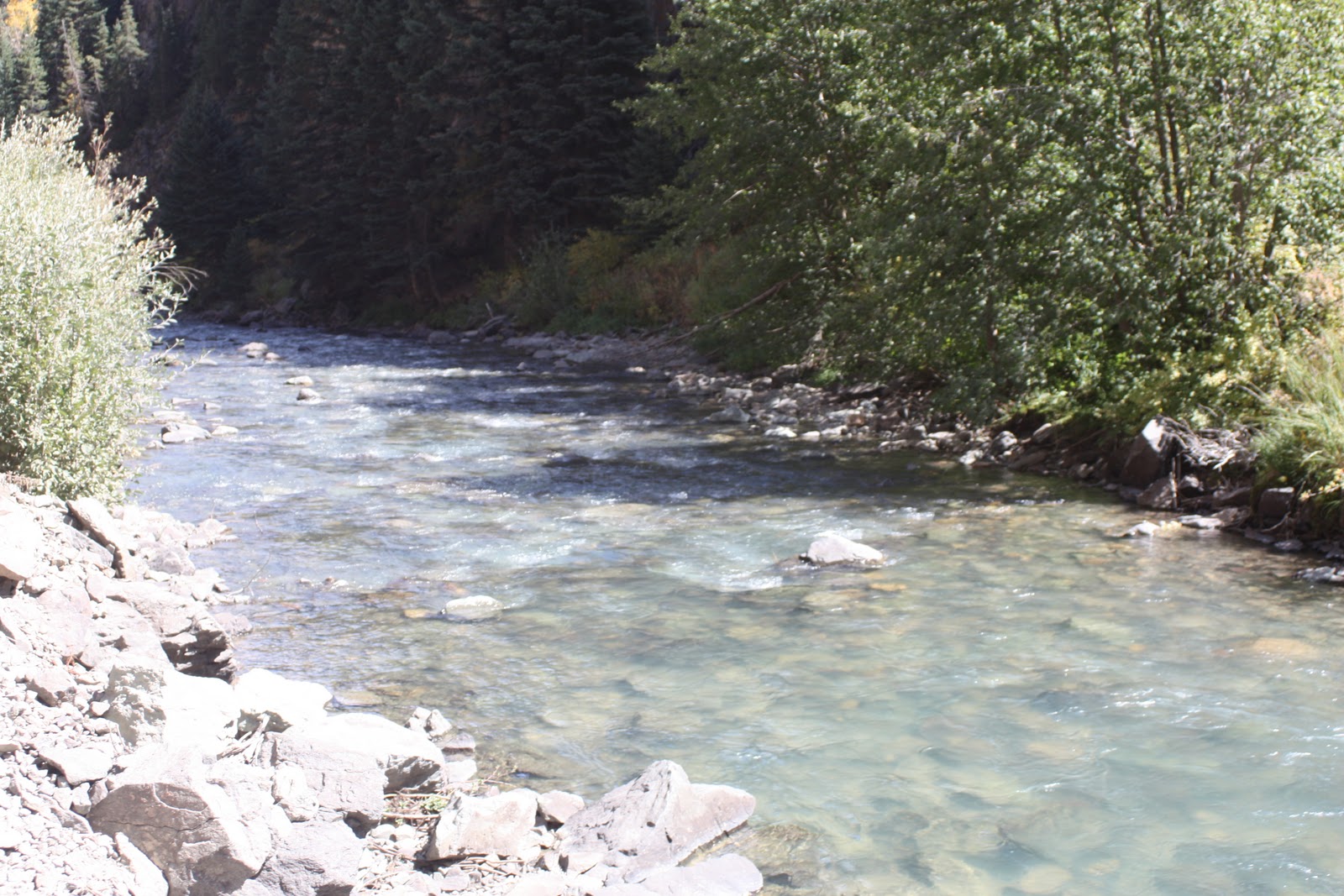
The lambs were swept away on this section of river.
See below for a picture of this same stretch of water
 during a return trip in September.
  The four ewes and one baby walked gradually uphill and away from the river.  Could the ewes be leaving their other babies behind?  As we watched through binoculars two ewes turned around and looked nervously toward the river.  They opened their mouths and called.  Still no sign of the lambs.  Then the ewes made their way farther uphill.  “We should leave”, I said.  “Our presence here by the river may be causing the ewes to move farther away from their babies—if the lambs are even still alive.”


Ewes call out for their lost lambs.
         
          As we returned to our cars Tim stopped and scanned the river, then he waved and pointed with enthusiasm.  “There they are! There they are!”  he shouted.  Four drenched lambs, about 50 yards downstream, out of the river and edging upstream along the rocks.  The lambs stood on a ledge around a corner and out of sight of the adults, but they must have called out to their mamas; suddenly three ewes came running down the hillside toward the river.  The lambs huddled by crevices in the rocks until their mothers came to get them.  Then the ewes and lambs—one Mom with her twins and the other two with their single lambs—celebrated a joyous reunion at the base of the rock face.  All seven bighorns then turned and picked their way over the rocks and up the mountainside, joining the other ewe and her lamb.  
Witnessing this extraordinary event were four speechless, ecstatic humans.


"I thought I'd lost you forever."
Notice how the baby lamb (on the right) blends in with the rocks.
          That evening I reflected on the day’s events and had these questions:  
  How did those little lambs survive when a person wouldn’t have lasted ten minutes in that icy, turbulent river?  How did they break free from the powerful current, scale the vertical riverbank and escape the churning water?  How did all four lambs find each other and end up together, and on the same side of the river as their mothers?  
           I’ll never know the answers.  A miracle. 
As I turned in for the night I imagined all the tiny lambs snuggled up with their mamas under a star-filled sky.  Safe.  And warm.  And dry.


"Follow me to safety, little one."


The Rocky Mountain Bighorn is a species in peril.  The National Bighorn Sheep Interpretive Center in Dubois, Wyoming encourages stewardship of bighorns and of all wildlife and wild places.  If you're interested in joining this organization (I have) or in learning more about Rocky Mountain Bighorn Sheep visit this address:   http://www.bighorn.org/

Below is a photo, taken several months later, of the same stretch of river where the lambs were swept away; the high waters have subsided.  Notice how placid the water is—much safer too.


Wednesday, July 20, 2011

Treasures of Hovenweep

The Ute Indians named this remote area on the Utah-Colorado border Hovenweep, meaning “deserted valley”.  The name is appropriate; as Tim and I drive south from Blanding to Hovenweep National Monument we’re the only vehicle for miles around.
We pull into the campground on a warm Friday afternoon in March.  The campground, set among junipers and pinyon pines, affords spectacular views of the  snow-capped San Juan mountains to the east.


A Room With a View - Campsite at
Hovenweep National Monument.

After making camp we walk the two mile interpretive trail near the visitor center.  This trail winds along the edge of a canyon and near ruins belonging to the ancient Pueblo Indians.  These structures, built from AD 1230 to 1275, are in remarkably good shape.  How many of our modern-day dwellings will survive 800 years?  As we walk we speculate on what life was like for the peoples of the Colorado Plateau all those years ago:  no roads or campgrounds; no noisy pick-up trucks hauling recreational vehicles; no radios blaring; no jet contrails in the sky.  For a moment I think I would’ve liked to have lived here in AD 1275.  Reality sets in though as we cook dinner at the campsite and I reflect on how convenient it is to have a propane stove heating our stew, to have a vehicle transporting us and our gear to this place.  After dinner we relax by a roaring fire—reading, talking and gazing at the stars.


Ruins Along the Rim Trail.

The following morning after a nourishing breakfast of eggs, hash browns and sausage we prepare to hike the Holly Ruins Trail.  The trailhead starts from the campground; it’s an 8-mile long out-and-back hike.  Near the trailhead the path cuts through a narrow crevice in the rocks; we get a kick out of squeezing through this fissure. The ruins at trail’s end are perched high on a canyon rim with sweeping views of the surrounding mountains and deserts.  Archeologists theorize that the Indians built here for defensive purposes and that’s likely true.  But I wonder...could it be that they liked the view just as we do?  Why do we assume that ancient tribal cultures had no sense of aesthetics, that they were only interested in the utilitarian nature of things?
 
         Tim and I enjoy the easy pace of the hike back to the campground.  Throughout the hike canyon wrens keep us company with their trilling whistles.  You can listen to the song of the canyon wren here:  http://www.youtube.com/watch?v=zkkDmg22SbU
This evening we relish our dinner of spaghetti, followed by s’mores around the campfire.  Tomorrow we’ll drive back to the 21st century but for now we’re savoring time spent in the shadows of ancestral Puebloan civilization.


Perched on the Rim - Townsite of the
Ancestral Pueblo Indians.


For more information on the ancient Pueblo Indians visit this website:   http://www.newmexicohistory.org/filedetails.php?fileID=1635


To plan your trip to Hovenweep National Monument visit this site:  http://www.nps.gov/hove/index.htm

Thursday, July 14, 2011

Wildflower Season in the Mountains

                People from a planet without flowers would think we must be mad with joy the whole time to have such things about us.
                                                                    -- Iris Murdoch
                                               A Fairly Honourable Defeat


               Wildflowers are blooming in the western mountains!  If you've been wondering what happens on the slopes of your favorite ski resorts in the summertime, then you might be interested in these photos from an August trip to Alta in the Wasatch Mountains of Utah:


Albion Basin Wildflower Meadow, Alta Utah


Indian Paintbrush


Pink and Blue Wild Geraniums


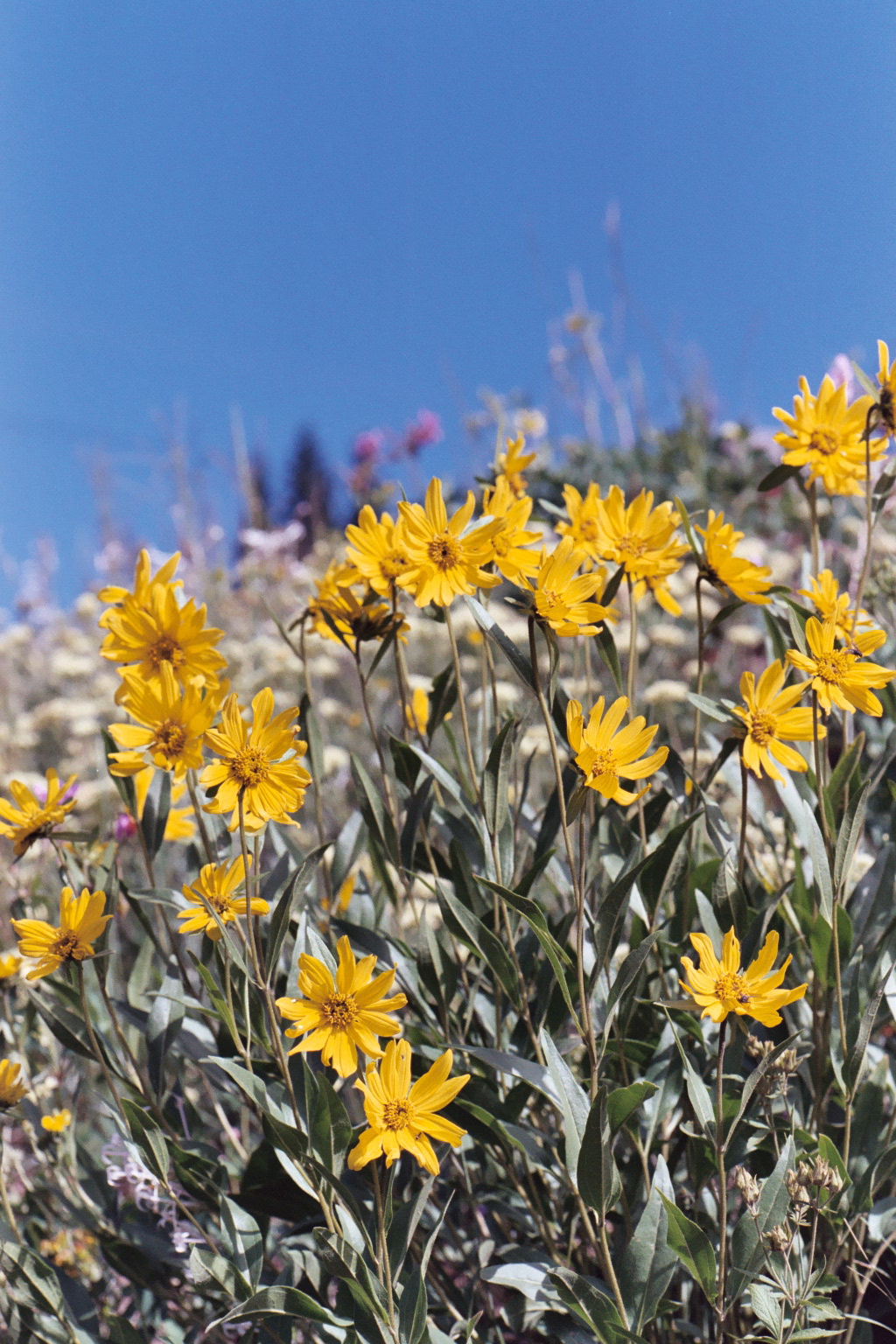
Yellow Daisies and Blue Sky


Silvery Lupine and Indian Paintbrush


Bursting with Color


              Several mountain  towns hold wildflower festivals during July and August.  You can find information about the Wasatch Wildflower Festival (Utah) and the Crested Butte Wildflower Festival (Colorado) on these websites: