Monday, January 28, 2013

Sunrise, Sunset at Bosque del Apache National Wildlife Refuge in San Antonio, New Mexico


         I don’t want to move, to speak, or even to breathe—so fearful am I of altering the dawn dreamscape before my eyes.  Burnt amber hues saturate the sky’s canvas. Then magenta appears, along with powder-puff blue.  Finally a roiling dusky orange steals in from above and below, threatening to engulf the heavens in flames.  We point our cameras skyward while the marshes at our feet reflect this celestial palette here on earth.

A pair of ducks float in a Kodachrome marsh.
         
         Where are we?  Bosque del Apache National Wildlife Refuge in San Antonio, New Mexico.  Tim and I have journeyed south to see the Sandhill Cranes and Snow Geese which congregate here in winter.  Flocks of cranes soar overhead, their prehistoric cries lingering in the air.  Clouds of geese rise as one from their nighttime watery roosts, the whirring of wings mimicking the roar of a jetliner powering up for take-off.

Top:  Snow geese awaken after a good night's sleep.
Middle:  The geese lift off as a single organism.
Bottom:  The flock fans out overhead.
  
 The birding is rewarding but the display of color and light at dusk and dawn is astonishing.   

No,  your eyes don't deceive you.  We witnessed
sunrises and sunsets like these every day.

Sandhill Cranes at Sunrise.

         Regular readers of this blog know I’m drawn to the natural world and I’ve gaped and gawked at many a stirring scene.  But this time was different.  For three days in January of 2000 Tim and I experienced sunrises and sunsets so reverent that at one point I turned to Tim and whispered:  “I can’t believe I’m alive to see this.” 

By the dawn's early light.

Silhouetted Sandhills at Sunset.

         I’ve not returned to Bosque del Apache and I can’t help but wonder whether or not the birds are still abundant, the sunrises and sunsets still ablaze.  
 Readers, have you experienced a jaw-dropping sunrise or sunset?  Where was it?

Birding and sky-gazing are not the only activities at
Bosque del Apache.  This hiking trail gives visitors a taste of
 southern New Mexico's desert.

Tuesday, January 15, 2013

Coyote Buttes—Wind Sculpture on the Utah/Arizona Border

         The next time you're outside on a windy day consider the wind's ability to construct masterpieces of nature.  Coyote Buttes, in the Paria Canyon/Vermillion Cliffs Wilderness, is a one-of-a-kind example of wind-sculpted natural works of art.

         Several years ago, on a cloudless January day, Tim and I hiked Coyote Buttes North, commonly called The Wave.  This panorama of ridges and swirls symbolizes wild America; you may have seen the images below in coffee-table books extolling our country's scenic landscapes.

Perhaps you've seen this image on the cover of a "Scenic America" book
or calendar.  It's even better in person.
         

Giant "Cinnabons" like these line the trail on the way to
Coyote Buttes North.

Tim stops to compose a shot of this
natural playground.

We discovered the ideal lunch spot—atop these
sun-warmed rocks on a cold winter day.

 When you find yourself standing in a spot like this,
remember to thank the wind.

This view shows the terrain traveled on the way to "The Wave".

          The 2.5 mile hike to Coyote Buttes North crosses sand and slickrock.  Visitation is limited in this fragile area and a permit is required for those wanting to access the trail.  Contact the Bureau of Land Management (BLM) office in Kanab, Utah for more information.
           And, just a reminder, desert hikes can be deadly in hot weather.   This sobering post is proof of that sad fact:  https://onedayinamerica.blogspot.com/2013/08/death-in-utah-desert.html

Monday, January 7, 2013

Home Ranch Winter Getaway, Clark, Colorado


         Entering this Currier and Ives Christmas-card scene by motor car seems wrong some how.  A horse-drawn sleigh should be carrying us to the entrance of Home Ranch in Clark, Colorado . . .

"It'll nearly be like a picture print from Currier and Ives..."
This quote from the song "Sleigh Ride" describes our feelings
on arrival at Home Ranch.
         The Ranch’s cheerful employees greet us as we walk in the door; we’re shown to our room, The Bonanza, where we unload our bags and suit up for an afternoon of cross-country skiing.  Aspen Arches trail takes off through a tunnel of aspens, and skirts the horse pasture.  

Tim skies the Aspen Arches trail.

         After skiing we have a tough decision to make—lounge in our room or soak in the outdoor hot tub?  We choose the hot tub and watch a family flying down the hill behind us on inner tubes, their screams of exhilaration the only noise filling this peaceful afternoon.
         Dining at the ranch takes place in a large rectangular room; a wood burning fireplace adorns one end, two long tables fill the remaining space.  It’s a communal dining experience and, if that’s not your style, you’re out of luck at The Home Ranch.  This evening we dine with a family from Connecticut.   Jackie and Franz (originally from Holland) and their two kids have been vacationing at Home Ranch for the past six years, and they love these western adventures.

Hot tub in the foreground (intentionally left dark) and tubing hill
in the background.
         The following morning, after a breakfast of flapjacks and poached eggs, we dress in our long-johns and winter coats for a ride on the feed sleigh.  We walk to the barn and find two Percherons named Bob and Bill hitched to the sleigh.  Six other people arrive for the ride and soon we’re on our way.  Our sleigh enters the horse pasture and our wrangler Brady asks for volunteers to unwrap the 1,500 pound bale of hay and spread it about for the herd.  Tim busies himself with that chore—he says it’s hard work!—while I inquire about the use of draft horses.  Brady tells me that Home Ranch prefers feeding its animals with horses and sleigh, as opposed to tractors and ATV’s.  Nice and quiet.  But these brutes eat a lot of hay during the winter—up to 50 pounds a day for each of the 1,700 pound draft horses.

Rita and Tim pose with Bob and Bill.

Tim (green coat and brown hat) helps with feeding time
in the pasture.
         This afternoon we sign on for a 45 minute horseback ride in the snow.  I ride gentle Sequoia and Tim rides Hopi on our escorted outing, weaving through meadows and aspen trees.  After the ride it’s time for a final ski on the Big Meadow trail.  The views stretch from horizon to horizon, from valley floor to mountain peaks.  

Rita and Sequoia out for an afternoon ride.

The Lone Ranger rides again: Tim and Hopi cut a
striking figure on the trail.

Tim skies the Big Meadow with its expansive views.

        It may not have inspired a Currier and Ives print, but a winter weekend at Home Ranch combines 19th century outdoor experiences with 21st century lodging for an unforgettable stay. 
Visit this website to plan your own Colorado winter getaway: http://www.homeranch.com/

Interested in Ranch Vacations?  Read my previous posting about a trip to Lone Mountain Ranch in Montana.

Sunday, December 30, 2012

Happy New Year from Steamboat Springs, Colorado

When I no longer thrill to the first snow of the season, I'll know I'm growing old.                                                                                                                                 
                                                                                                        ---Lady Bird Johnson

         I'm in agreement with the former first lady on the above sentiment.  Tim and I recently snowshoed our first powder snowfall of the season at Rabbit Ears Pass, southeast of Steamboat Springs, Colorado.

         On the trail we passed two families on a tree-finding expedition—Dad carrying the saw in hand, kids flopping in the snow banks, Mom laughing and snapping pictures.  Later we saw them trekking back to their cars, spruce trees in tow.  It's a family tradition in Routt National Forest country.

        We left the main trail for a lightly used path and found our own little group of Christmas trees with dollops of snow icing on their branches and powdery flakes falling around them.  We took only photos, leaving the evergreens behind for others to enjoy.

 Click below to view a short slideshow (less than one minute) from our first winter frolic:


Sunday, December 16, 2012

Snowshoeing Boulder Mountain, Utah


         Snowshoeing Boulder Mountain in south-central Utah is always a thrill.  Scenic Highway 24 climbs the Boulders, reaches 9600 feet in elevation, and offers numerous plowed pull-outs near the summit.   From there, uphill treks to snow-covered mountain meadows provide views into Capitol Reef National Park and beyond. 

Tim pauses to take in the view of Capitol Reef National Park and the
snow-capped Henry Mountains.

Slightly higher on the mountain (and a year earlier) than the above
photo, Rita is walking in a winter wonderland.

          Boulder Mountain rises to 11000 feet and is the place to find snow, even in years when snowfall totals are lean elsewhere in southern Utah.  Every winter we make an effort to snowshoe the Boulders.  These pictures are some of our favorites from outings over the past four years. 

Surveying my universe through a stand of aspens.

           One year we emerged from an aspen thicket into a clearing to find four trees apart from the grove.  These specimens were enormous—among the biggest, and probably the oldest, aspens I’ve ever seen.  The photos below show the grandeur of the "four ancients". 

Tim stands dwarfed by the four giant aspens.

The old aspen raises its branches into Utah's sunny skies.

         Snowshoeing is a fantastic winter activity that most anyone can enjoy.  Readers, do you have a favorite place to snowshoe?  How about somewhere you've always wanted to snowshoe but never had the chance?  For me, that would be Yosemite National Park.  Maybe someday...

Our day of snowshoeing has come to an end.
Tim glides downhill to our waiting vehicle.

To read about another snowshoeing adventure click here: Snowshoeing in Bryce Canyon National Park

Saturday, December 8, 2012

Climbing Handies Peak in Colorado's San Juan Mountains


          “Because it’s there.”  British climber George Mallory reportedly uttered these famous words when asked why he wanted to climb Mt. Everest.  I have another reason for ascending lofty peaks:  “For the million dollar views.”


View of the Handies Peak area from the trailhead.
The trail passes below the snowfield; Handies Peak is to the left of
the picture.
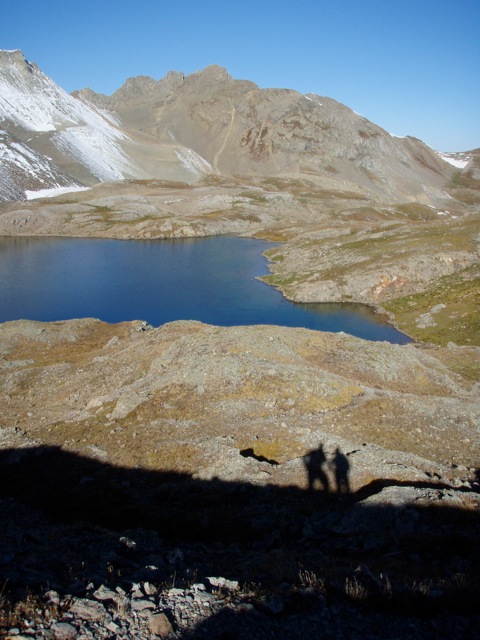
          Handies Peak is our destination on a blue-sky September day in the San Juan Mountains of southwestern Colorado.  We arrive at the trailhead in the early morning and begin the 2600 foot, two mile ascent.  An hour and 20 minutes later we reach our first break point, Sloan Lake—a blue-green gem nestled into snow-sprinkled peaks.


Tim captures our silhouettes as we pause to
appreciate Sloan Lake.
          A few minutes later we continue on from Sloan Lake, on a near vertical trail heading for the saddle (high pass between two peaks).  Something doesn’t look right; Tim reaches the saddle and is surrounded by knife-edge peaks.  This was not in the trail description.  We slide down the scree-covered slope back to Sloan Lake and find the turn-off for the trail, an unmarked “T” junction on the downslope side of the lake.


Moving on from Sloan Lake.  The Lake is nestled in the depression
on the lower right of the photo.  You can see the trail snaking its way
across the talus on the lower left.
          We make our way across a talus field, then up a series of switchbacks to another saddle.  From there we can see the summit, only a few hundred yards away.  The air is thin and it’s slow-going to the summit but when we reach the 14,048' peak it’s worth every step.  The view from the top encompasses 8000 square miles of San Juan splendor.


I'm ascending the switch-backing trail to the summit.


The view from 14,048 feet.
          For a few precious minutes we have this glorious perch all to ourselves, then we spy two men making their way up the slope to join us on the summit.  The men are from Durango and they’ve climbed Handies Peak today to celebrate the older of the two’s 60th birthday.  The younger man, in his 50’s, has climbed 30 of Colorado’s fifty-three 14ers—peaks higher than 14,000 feet.  
We congratulate the men on their accomplishments, and on their choice of this spot for a 60th birthday get-away, and then we descend.  A day spent on top of the world, reveling in million dollar views?  Priceless.

Speaking of priceless views, in September of 2005 Tim and I hiked to the summit of Uncompahgre Peak.  At 14,321 feet it's the tallest peak in the San Juan Mountains.  Read about it here.  

Read about our attempt to hike another 14er in the San Juan Mountains --  Red Cloud Peak


Read about Handies Peak on the "Colorado Fourteeners Initiative" website:  http://www.14ers.org/peaks/san-juan-mountains/handies-peak/
Discover Colorado's San Juan Mountains by visiting this site:  http://www.americansouthwest.net/colorado/san_juan_mountains/


Thursday, November 29, 2012

Autumn Along the Grand Canyon's North Rim


          North Rim or South Rim?  The choice is yours when visiting Grand Canyon National Park.  Most visitors enter from the south, passing through the gateway town of Tusayan which offers all the amenities—an airport, shops, hotels, even an IMAX theater.  During an autumn visit several years ago Tim and I chose the quieter north entrance and encountered a herd of bison grazing a meadow on the Kaibab Plateau.

        Indoor lodging on the North Rim is limited to the Grand Canyon Lodge—North Rim.  We checked into our Western Cabin, then booked dinner reservations for the lodge’s dining room.   From the lodge we drove along the rim, stopping at two lookout points—Cape Royal and Point Imperial—along the way.  Cape Royal offers a half mile trail to the point.  We walked through stands of pinyon pine, enjoying the canyon views.  The trail passes through Walhalla Ruins, an old settlement of ancient Pueblo Indians.  I wondered:  Did the Pueblos pick this spot for its scenic beauty, or as a strategic place to escape predators and other tribes?  We’ll never know.

View from Cape Royal Point.

At Cape Royal, I'm sitting over an area named "Angel's Window".

         After photographing the canyon we drove through the only full-service campground on the North Rim.  Families were checking in, setting up camp, busying themselves around their campsites, and I was reminded of all the campgrounds I’ve stayed in over the years.  And, unlike most people at the North Rim who are probably thinking “Thank goodness I’m staying in the lodge”, I found myself watching the happy campers and thinking:  “Isn’t this wonderful; how great to be staying and sleeping outdoors on a pristine October day.”  
        Back at our cabin we relaxed and read (Bram Stoker’s “Dracula” for me), and then walked to the main lodge for dinner.   Seated by large picture windows, we watched the setting sun pour its light over millions of years of rock layers in the canyon. We couldn’t have asked for better seats for dinner.  And the food was great too; I enjoyed salmon pasta and Tim feasted on pork with mushroom and green salsa sauce. For dessert, we shared chocolate cake with mint chocolate chip ice cream.


Sunrise on the North Rim.
View into the Grand Canyon from the cabin area of
The Grand Canyon Lodge—North Rim.


          In the morning I woke early to photograph sunrise in the canyon.  Bright Angel Trail, a three minute walk from the cabin, provides unparalleled canyon vistas.  As the sun peaked through the clouds ravens flew overhead, heralding a glorious start to the new day.
        We returned to the lodge for breakfast; I don’t know about you, but for me nothing quite compares with sipping morning coffee and tea on the edge of the Grand Canyon.
        Today’s plan: hiking in the park.  After breakfast we found the Widforss trailhead, named for Gunnar Widforss—an early 20th century artist who lived in and painted the Grand Canyon.  The trail winds for five miles along the canyon rim and through a spruce and fir forest.  At mile 2.5 we heard the piercing cry of a Redtail Hawk and were treated to the sight of two hawks circling overhead.  
        We turned around at that point and decided to hike partway on the Kaibab trail which descends into the canyon.  The Kaibab is the trail into the Grand Canyon—on it you can walk rim-to-rim from the north to the south, or vice versa.  Tim and I only hiked 3/4 of a mile to the Coconcino overlook, a ledge affording sweeping views of the trail down-canyon.  Mule riders, out for a four-hour afternoon trail ride, passed by on their way down.  Looks like fun, but it’s an activity that will have to wait for our next visit.


October is a wonderful time of year to visit The North Rim.


Tree-framed views are common on the Widforss Trail.

Mule riders descend into the canyon on the Kaibab Trail.

         Readers, which would you choose—the hustle and bustle of the South Rim, or the laid-back atmosphere of the North Rim?  Either way, you can’t go wrong with a day spent in Grand Canyon National Park.