Monday, January 13, 2014

Rough Air

                            
               "Come fly with me, let's fly, let's fly away…"
                                                                                      --- from the song "Let's Fly Away"
                                                                                           lyrics by Sammy Cahn
                                                                                           performed by Frank Sinatra, 1957

             The words and melody sound so inviting when Frank sings them, don't they?  But it's 2014, not 1957, and the romance of air travel has gone the way of bobby socks and the Rat Pack.

             Sunday, December 19, 2010
           
             After an idyllic vacation on the Oregon coast Tim and I are in the Eugene airport, waiting to board our flight to Salt Lake City, UT.  The gate agent announced a minor delay due to maintenance problems.  But within half an hour we boarded the plane.  Shortly after takeoff the captain assured us of a quick, smooth flight to Salt Lake City and a near on-time arrival of 3:50 p.m.  We looked forward to seeing our cats, turning on the holiday lights, listening to Christmas CDs and relaxing—a quiet Sunday evening at home.
             Two minutes after the captain's message the commuter jet slowed, turned and began a descent.  I tugged on Tim's sleeve and said:
           "This should never happen on take-off."
             Another minute and another message from the captain.
            "Folks—from the flight deck—you may have noticed that we're descending.  A warning light has alerted the crew to a mechanical failure in the plane's deicing system."
              Back to Eugene we go.  With the airport in sight the wheels rumbled down into their locked, landing position.
              "Mommy!  We're crashing!", said a six-year-old seated behind us.  Reassuring.
               We landed (without incident), then off-loaded and waited.  A short while later another announcement from the gate:
              "Due to the de-icing system failure our jet is not safe to fly.  Please get in line to be reassigned to another flight."
             
               Tim entered the long line while I phoned Delta.  I reached an agent who told me there was a single seat on a Horizon flight leaving in an hour for Portland; from Portland a flight leaves for Salt Lake at 6:15 and will arrive at 9:00 p.m.  Tim must be on that flight; he has a full day of surgeries scheduled for tomorrow.  The agent gave me a confirmation number for Tim, then put me on a flight leaving Eugene in the morning.  Tim left for the Horizon gate and I got back in line to get my ticket and make arrangements for our luggage and for my overnight stay in Eugene.  Almost an hour later I approached the counter as Tim rushed to my side.  Horizon Airlines won't take his confirmation number, they need an actual ticket from the Delta agent.
               "Oh," the Delta agent said to me, "As it happens there are many empty seats on that flight to Portland.  Would you like to be assigned to that flight?"
                Yes, I would.  I grabbed my ticket, hurried to the Horizon gate with Tim, was the last person to board the flight and... the plane was only half-full of passengers.  Shouldn't the Delta agent I spoke with on the phone an hour ago have known that?  Well, anyway, we had a smooth 20 minute flight to Portland and were a couple hours early for our 6:15 flight to Salt Lake.  We checked the departure board and, what's this?  Our flight to Salt Lake has been delayed until 9:15.  Now we had time for a sit-down dinner where we could at least use the measly $6.00 voucher issued to us by a Delta representative.

Catching some shut eye while waiting—and waiting—for the
flight home.
             
                Back at the gate we read that the flight was now delayed until 10:00 p.m.
               "What's the problem?"  I asked the gate agent.
               "Well," she said. "The plane is still in Salt Lake and hasn't taken off due to a mechanical problem with refueling."  Delta had used the same excuse for our delayed flight from Salt Lake City to Eugene earlier in the week.
                 Oh really?  Here's the thing:  I just read that Delta raked in almost 1 billion dollars in revenue from baggage fees last year.  Shouldn't Delta take some of that one billion in cash and maintain their planes?  Or maybe they could hand out meal vouchers worth more than six dollars.

                 Finally, at 10:15 p.m., we took off for Salt Lake.  The flight was smooth until the descent into the Salt Lake Valley.  A mighty wind took hold of our small jet, tossing us up and down and side to side.  With queasy stomachs we stumbled to baggage claim, only to find our luggage hadn't made the trip.  Time to stand in line again.  We handed our claim checks to the clerk.
               "Your luggage is still on the plane in Eugene and I have no idea when it will arrive.  Fill out your name and address and we'll put it on a FedEx truck for delivery when it gets to Salt Lake."
                We were home by 3:45 a.m., a full 12 hours after we had expected to arrive in Salt Lake City.

                Wednesday, December 22, 2010
             
                Steady rain all day and still no sign of my luggage.  But when I opened the side door this morning Tim's bag was on the side porch, soaking wet.  FedEx must have dropped it off last night and forgot to ring the doorbell.  I emptied the bag of its sopping contents and hung the clothing to dry.  This afternoon my bag showed up on our doorstep as well, with a San Francisco baggage tag.  I hope my bag had a nice layover in the city by the bay.

                 Our Oregon coast vacation was delightful.  The return trip, not so much.  Oh, I'll continue to fly; it's still the best way to get quickly from here to there.  But the skies are many times less-than-friendly, and jet-setting is not what was in Frank Sinatra's day.
                 Readers, do you have a nightmare flight story?
               
                Wishing everyone safe, happy, and on-time arrivals in 2014!
               

Wednesday, December 18, 2013

Snowshoeing near Lake City, Colorado

                          Season's Greetings from One Day in America!
          Snowshoeing is one of my favorite outdoor activities and the mountains of southwestern Colorado provide a perfect venue for this winter sport.
          The photos below tell the story of two recent treks in the San Juan Mountains.

Our dog, Annie, leads the way on a trail through the
snowy spruce forest.

Reaching the rim.

Annie and I pose on a rocky outcrop with a killer view.
Annie doesn't appreciate the view but she loves
playing in the snow.


Zoomed view from the above photo.  Two of Colorado's 14,000 ft.
peaks dominate the skyline:  Uncompahgre (14308') on the right and
Wetterhorn (14016') to the left.

For more information on winter fun in and around Lake City, Colorado visit this website: http://www.lakecity.com/index.php/things-to-do/winter-in-lake-city


Another day of winter adventure dawns in the Colorado mountains.


Monday, November 11, 2013

Hawk Mountain Sanctuary, Kempton, Pennsylvania


                      "The time to protect a species is while it's still common."
                                                                                                 --Rosalie Edge
                                                                                          
Hawk Mountain is located under the Atlantic Flyway, a
principal route for migrating birds.

         “Eagle, high over Five. Sharpy coming in over Owl’s Head.” 
          Dozens of pairs of binoculars rise, their owners heeding the command to scan the skies over the above-named ridges.  The directive sounds like code for incoming missiles, but the raptors filling the sky today are not military but avian—a majestic Golden Eagle and a sleek Sharp-shinned Hawk.  


Birders search the skies above ridge "Five", hoping
to catch a glimpse of an Eagle.


The view from North Lookout.

          I’m part of the crowd seated on the rocks of North Lookout at Hawk Mountain Sanctuary in Kempton, Pennsylvania.  We gaze skyward at the soaring birds, the tranquility of this moment belying the carnage which occurred here 80 to 100 years ago.  During the first decades of the 20th century thousands of migrating hawks, eagles and falcons were gunned down—injured and killed for fun by so-called “sportsmen”.  Horrified by reports of the wanton slaughter, New York socialite Rosalie Edge leased these woodlands in 1934 and stationed wardens in the area.  Ms. Edge invited the public to visit and to bird-watch; four years later Hawk Mountain became the world’s first refuge for birds of prey. 


Hunters in the early 1900s traveled to the mountain
along old horse-and-wagon trails.
This ledge is only 100 yards from the roadway, providing a
veritable shooting gallery for the hawk slaughter.
          Before leaving our rocky perch to hike the 1.1 mile trail back to the Visitor Center one more directive is issued from the Hawk Mountain intern staffing the lookout today:  “Incoming, directly overhead.”  It’s a Merlin, dive-bombing the owl statue standing guard over the spectators at North Lookout.
         Today it’s birds—not bullets—flying overhead, and the only shots being taken are photographs.  Thanks to Rosalie Edge the rolling ridges surrounding Hawk Mountain Sanctuary remain a safe haven—for both humans and raptors.


A spotting scope is trained on peaks "One" through "Five".

           Hawk Mountain Sanctuary is located in southeast-central Pennsylvania, near the Appalachian Trail.  Every day during the fall migration a staff member is stationed on the lookout to conduct an official bird count and to help visitors with raptor identification.  
          Crowds can be prohibitive on weekends during fall color season (most of the month of October).  November is my favorite month to visit the North Lookout.

Learn more about Hawk Mountain by visiting their website:  http://hawkmountain.org


Two tales of one trail.  The top photo was taken on the North Lookout
trail in September of 2013.  The bottom picture was taken on the
same trail in November of 2008.  If you're dressed for
the weather, November offers great views and no crowds.
(Bring along a thermos of hot chocolate.)


Friday, October 25, 2013

A 95 Year Tradition of Food and Fun at The Ephrata Street Fair, Ephrata, PA

Is that grease on the napkins?  You bet.  As one of the Akron (PA) Lions
used to advertise while tending the sizzling spuds:  "Crisp and mellow,
golden yellow, golly but they're good!"
         Begin one of my blog posts with a food photo?  Yes, if it's a dinner you can eat for only five days of the year.  During those days at the end of September, parts of Ephrata's Main and State streets are closed to host the largest street fair in the state of Pennsylvania.
         Crowds gather and walk the streets to find scores of food kiosks, games of chance, and both kiddie and adult thrill rides.  Several blocks away in the town park the agricultural tent houses livestock to show and sell, as well as canned goods to be judged.
         Now, about that special meal . . .  You can buy all the sausage sandwiches, barbecue and funnel cakes you can eat but none of it compares with the Akron Lions crispy fries and their signature sandwich—the toasted cheese burger.   Many decades ago the Lions sold grilled cheese sandwiches and hamburgers separately.  One day at the stand a bold Lion decided to pop a juicy burger inside his grilled cheese sandwich and, voila!, a delicacy was born.  Now the Lions sell upwards of 15,000 of these sandwiches at the fair every year, and they bring home ~$50,000 in profits for their charitable organization.  My father has been a proud Akron Lion for 54 years and, for many of those years, he worked the stand on its busiest nights.  When my dad sold sandwiches he picked up the tab for my annual toasted cheeseburger habit.
       You can still line up at the "Queen of the Midway" and order either a plain burger or a grilled cheese sandwich but, with those toasted cheese burgers staring you in the face, why would you?

Scores of people wait in line at the Akron Lions Stand for a chance to
sink their teeth (man at bottom right) into one of those tasty
toasted cheese sandwiches.

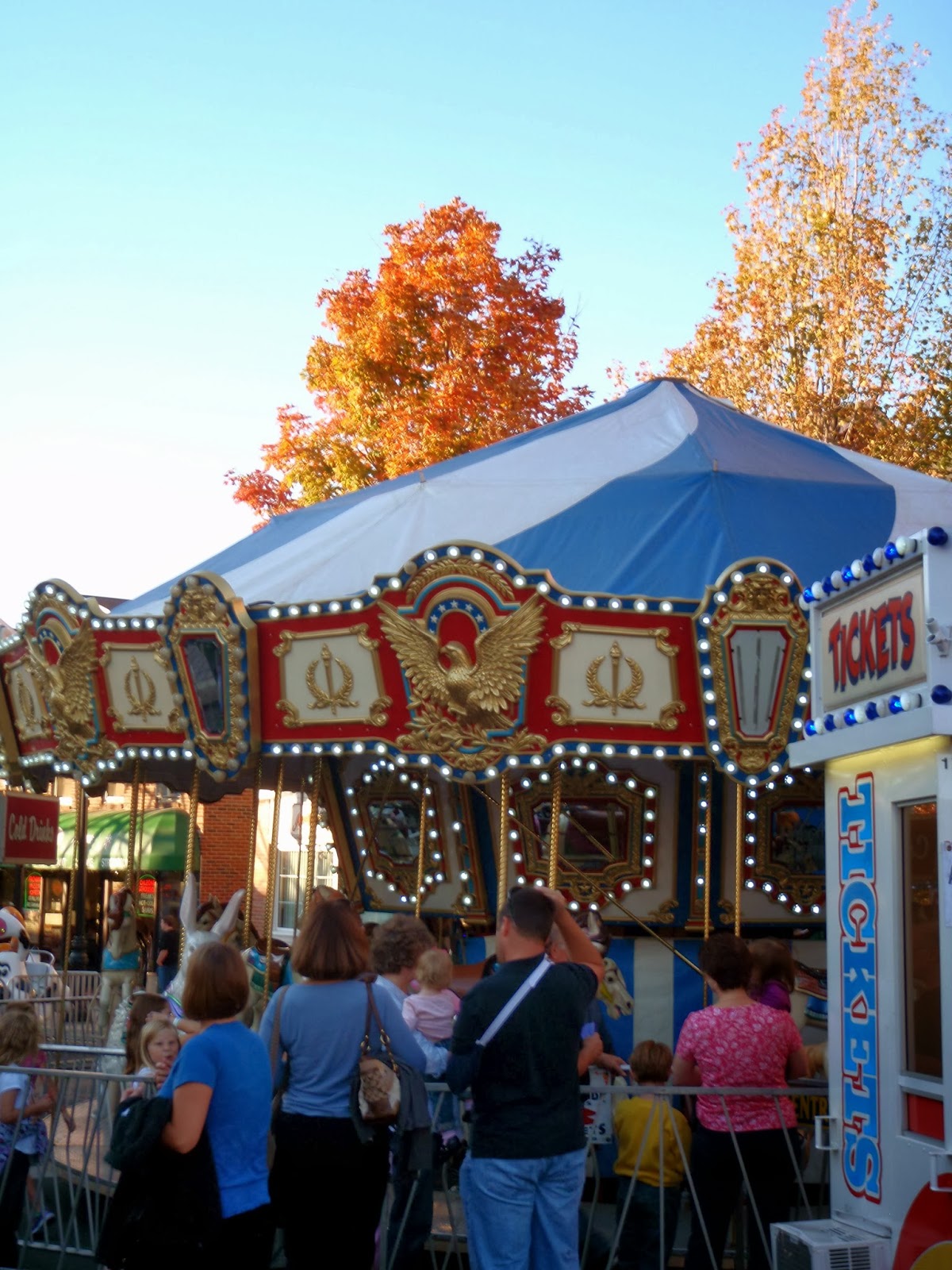
The Merry-go-Round attracts the younger crowd and their
parents on a stellar autumn evening.

         While the tradition of fine food at the Akron Lions stand will continue, another long-standing tradition at the Ephrata Fair is coming to an end.  For the past 42 years Walt and Joan Dembroski have been traveling from Florida to bring their "Fat Albert" wheel-of-chance game to the fair.  I played the game for 25 cents when I was in high school—back when Walt and Joan were young.  Now in their 70's Walt and Joan announced this would be their final year at the fair.  Huge crowds lined their stand every night, everyone plopping down their 50 cents, (or three tries for a dollar) for their chance to win a prize.

A piece of cheese is placed in each cup under the board's colors.
Walt places Fat Albert the rat in the cup at the center of the wheel
and gives the wheel a spin.  Which color will the rat run into?
On this spin it looks as though Fat Albert is heading for light yellow.

Another game of chance next to the Funnel Cakes.
Shoot a bullseye and take home one of these stuffed animals.


Crowds fill the midway on Friday night at the fair.

Sheldon's Gallery and Store welcomes fair-goers to Ephrata's Main Street.

         The Ephrata fair begins on a Tuesday night.  The Ephrata parade, filled with floats, marching bands, baton twirlers and more is the unofficial Wednesday evening kick-off for the festivities.
         Readers, did the town you grew up in have its own annual fair, farm show or carnival?  Do you have fond memories of special foods, exhibits, games or rides?
         Learn more about the Ephrata Fair by visiting their website: http://www.ephratafair.org/

Wednesday, September 25, 2013

Touring the Hard Tack Mine in Lake City, Colorado


         Think your job is tough?  Then you haven’t spent 40 minutes touring the Hard Tack Mine near Lake City Colorado.  Tour guide Billy Tuggle shares the perils of mining with our group as we journey along a tunnel inside the San Juan Mountains.  Gold and silver miners were exposed to constant hazards, among them cave-ins and explosions.  Many of the men who set the charges in mines like this one never made it back to town alive.  


  We stop at displays along the tunnel, where mannequins re-enact scenes of chiseling precious minerals from the mountainside while Billy provides a comprehensive narration detailing their efforts.   Near the end of the tour we’re treated to a special surprise—an underground room filled with stunning examples of the gems extracted from the earth.


A warning.  Old mines are subject to
toxic fumes and cave-ins.

This grizzled "miner" is ready to drill into the mountainside.

         As we finish our excursion Billy shares a secret with us: this part of Colorado still contains traces of silver and gold, and Billy has discovered 500 pounds of silver-containing rocks in his travels of the San Juans.  When we leave the tunnel Billy’s wife Bobbi is waiting in the underground gift shop, where we can buy samples of the precious stones found in these hills.


"Know when to fold 'em..."  Even miners have to relax now and again.
My friend Shirley plays a hand in the miner's lounge.
         So go ahead and try your prospecting luck in the mountains of southwestern Colorado—but don’t become another mining statistic.  The Bureau of Land Management (BLM) has published a brochure detailing rules and guidelines for aspiring rock collectors.  Read all about it at this website:  http://www.blm.gov/pgdata/etc/medialib/blm/co/programs/minerals.Par.44677.File.dat/Rockhounding Brochure.pdf


The mountains of southwestern Colorado are dotted with the
remains of old mining townsites.

         The Hard Tack Mine is open every day from Memorial Day until Labor Day.  The rest of the year the mine is open by appointment.  Contact the mine at this number: 970-944-2506.

Wednesday, August 28, 2013

Death in the Utah Desert


         It’s a glorious summer day, seemingly perfect for hiking among the folds and formations of Utah’s Red Rock deserts.  But the temperature has climbed past 100 degrees and you’ve run out of water on the return to the trailhead.  And the sun—a warm blanket wrapped around your shoulders this morning—has by afternoon become an iron smelter encasing your body in a pot of molten ore.  You feel headachy, your pulse and respiration rise, you lose coordination and your pace slows.  You’re suffering from heat exhaustion and, if your body temperature continues to rise and the body’s cooling mechanism collapses, heat stroke will result.   Delirium, organ failure, convulsions, and coma will lead to death.

****

       Six people have died while hiking in southern Utah this summer, five of them on trails I’ve hiked and blogged about.  While my blog posts are filled with the wonders these trails have to offer, it’s only fair to point out that Utah's rugged wilderness can be as deadly as it is delightful. 
        Below is a brief synopsis of this summer’s tragedy on the trails:

The Wave (Coyote Buttes) on the Utah-Arizona border. 
         A husband and wife, ages 70 and 69, were returning to the trailhead when they suffered the effects of dehydration and heat stroke.  Their bodies were found 250 yards apart.  One week later a 27 year-old woman, on a fifth anniversary trip with her husband, lost the trail for two hours, then collapsed from heat exhaustion.  Her husband hiked out for help; by the time rescuers reached the woman she had died.


The Wave.  Notice the water bottle at the side of my pack.
I carried two 32 oz. bottles—and it was a January day.

Horseshoe Canyon (Great Gallery) in Canyonlands National Park. 
        A 73 year-old man, hiking alone, failed to contact his family at the designated time and a  search party was launched.  His vehicle was found at the trailhead and his body was found along the trail.  Heat stroke and dehydration were determined to be the cause of death.


The black arrow points to me as I hike into Horseshoe Canyon.
Notice the total lack of shade and water along this trail.

Spooky and Peekaboo Slot Canyons in Grand Staircase Escalante National Monument.
        A 35-year-old woman, hiking with a friend, struggled in the heat on the way back to the trailhead.  According to the Salt Lake Tribune she had packed three liters of water and a 32 oz. bottle of Gatorade.  She and her companion became lost for two hours but eventually found the trail and were within a quarter mile of the trailhead when the woman couldn’t go on.  Her friend ran to the trailhead and called 911.  When she returned to the trail the woman had no pulse and was not breathing.  The friend performed CPR for an hour until medics arrived.  The victim was transported to a hospital but did not survive.


Tim and his friend Mark descend into Spooky Gulch.
Our destination is the trees at the canyon's bottom.
This was one hike we did complete in the summer
—with plenty of hydration.

Brimhall Double Bridge Trail in Capitol Reef National Park. 
        A 56-year-old woman, hiking with her husband, became ill on the trail.  Her husband hiked out for help but by the time emergency personnel arrived the woman had died.  Heat exhaustion/stroke is the presumed cause of death.

**** 

Of the four trails mentioned above, Brimhall Double Bridge is the only trail I haven’t tried.  Having previously suffered the effects of beginning hyperthermia I tend to avoid desert trails in the excessive heat of summer.  If summer is the only time you have available to hike Utah’s deserts I recommend drinking at least a gallon of water, and hiking in the early morning or early evening.  
Enjoy the eternal beauty of the desert but please... be careful out there, and prevent a dreamy summer day from turning into a nightmare.

Monday, August 12, 2013

Cruising Lake Champlain with Whistling Man Schooner Company, Burlington, Vermont


          Lightening bolts branch across the lake.  A storm is brewing.  I tilt my head to gaze at the canvas sails reaching to the sky.  
“What are the chances this boat could tip?” I ask.  
“Impossible,”  replies the captain.
Captain Mike and first mate Tyler check the radar on their iphones, then assure me the storm is moving to the south and away from us.


Storm clouds building?  Not to worry.
Friendship sloops are built to handle the weather.
         I’m the only passenger this afternoon aboard the Friend Ship— a Friendship Sloop modeled after Maine sailing vessels first built in Friendship, Maine in the late 1800s.  Our craft was built in 1981.  It’s 46 feet long, weighs almost 19,000 pounds and has a 4,800 pound keel—thus the improbability of being tossed into the water.  
On the Atlantic coast these ships were built for fisherman and lobstermen.  In Burlington, Vermont, shipbuilders fashioned the boats for light cargo and recreation.  And recreation is the purpose of my sail today with Whistling Man Schooner Company, which offers daily cruises on Lake Champlain during the summer.  


My own private tour on the comfortable Friend Ship.
Captain Mike invites guests to bring their own food and drink;
wine and cheese are favored on the Sunset Cruise.

         As we sailed the smooth waters Captain Mike told of the history of Lake Champlain.  This waterway was important to the French and British in Canada as a way to transport goods to the Atlantic seacoast; therefore the lake became a critical strategic area during the battle with the British for control of the colonies.  
        George Washington sent men and boats (precursors to the US Navy) to capture the forts along the lake.  If they succeeded the colonial army would gain control of the lake—the most direct invasion route to British Canada.  However, if the British maintained their presence on the lake they would be able to divide and conquer the colonies.  We all know who won this conflict, but the historical significance of Lake Champlain is interesting none-the-less.


Burlington is the largest city in Vermont.  Views of Lake Champlain
abound in this hilly city.


Looking through the rigging toward New York State.

       Captain Mike also relayed his own history.  He worked for IBM for 29 years and was laid off in 2010.  One year later he landed a consulting job with IBM, but in the meantime he added to his lifelong love of sailing by securing his Captain’s license.  A year after that the Whistling Man Schooner Company went up for sale.  
“Should I buy it?” he asked his wife.  “Go for it,” she said.  
And so, Captain Mike quit IBM for good and began taking passengers for cruises on Lake Champlain.  He has no regrets:  “It’s a wonderful life,” he said.  
        I have to agree.  The storm has moved away and, on a warm July afternoon, there’s nothing better than relaxing on the deck of the Friend Ship while sailing Lake Champlain.


Captain Mike and Tyler, enjoying the sailing life.


The Friend Ship in dock and waiting for the
popular 6:30 p.m. Sunset Cruise.

To learn more about the Whistling Man Schooner Company visit their website:  http://whistlingman.com/