 |
| Main Street USA. Vernal, Utah is the gateway city to Dinosaur National Monument. One of Vernal's unofficial mascots, "Dino" the dinosaur, is dressed for holiday fun. |

This blog showcases my fascination with travel into the heart of America. Each blog post will transport readers from behind their screens and into the realm of the American experience. My goal is to inspire people with tales of travel and discovery and to motivate them to explore the world beyond their doorsteps.
Friday, July 3, 2015
Happy 239th Birthday, USA!
Tomorrow, July 4, 2015, Americans everywhere will be celebrating Independence Day with picnics, parades and pyrotechnics. Have a Happy Holiday!

Tuesday, May 19, 2015
Sand Wash Herd Management Area in Moffat County, Colorado
"Did you see Picasso?" The question comes from a portly middle-aged man sporting a long-lens camera around his neck. Unsure exactly what he's asking Tim and I answer with a short "Uh, no," and move on.
Reflecting on his question later I realized that today we have seen irregular patterns of black and brown, a not-quite-pink combination of cream and beige, black mixed with roan to create a speckled blue. I refer though, not to paintings by famous artists, but to wild horses.
Native wild horses disappeared from North America thousands of years ago. The horses we're viewing today are descendants of horses which escaped during the Spanish conquest of our continent in the 1500s. The controversy surrounding wild horses is this: Are they truly wild, or are they an invasive species? Biologists tell us that domesticated horses revert quickly to their ancient behavioral patterns if lost or abandoned. Considering that these horses have been roaming free on the land for 500 years, I would say they're more native than I am.
Human settlements in the west—and endless miles of fencing—are now the biggest obstacles to free-ranging wild horses. Even in sparsely populated Moffat County, Colorado the wild herd is managed by the Bureau of Land Management to keep their numbers from overwhelming the designated habitat. But, fortunately for these horses, the 156,500 acres of the herd management area in Sand Wash Basin sustains a healthy population. And that population is filled with animals sporting every possible color combination.
Now we get it. The gentleman with the camera was asking about a horse named "Picasso", most likely one exhibiting Picasso-esque colors. So did we see him? A Google search reveals multiple photos of the famed wild stallion and our question is answered.
No, we didn't see "Picasso" this day in the basin. But it was an excellent day on the range, in the company of wild horses.
Plan your wild horse-viewing get-away in the wild country of northwestern Colorado by visiting this website:http://www.blm.gov/co/st/en/fo/lsfo/programs/wild_horse.html
Note: This is a remote and rugged region with the nearest services (limited) 25-30 miles away. Be prepared when traveling in this area.
Reflecting on his question later I realized that today we have seen irregular patterns of black and brown, a not-quite-pink combination of cream and beige, black mixed with roan to create a speckled blue. I refer though, not to paintings by famous artists, but to wild horses.
 |
| Several of the horses we saw while driving the "Wild Horse Loop" displayed a healthy interest in us. This horse watched us for several minutes before slowly turning away. |
 |
| This small group of wild horses grazes the sage-covered high plains of northwestern Colorado. |
 |
| We were fortunate to encounter this little filly and her mother by the side of the road. |
Human settlements in the west—and endless miles of fencing—are now the biggest obstacles to free-ranging wild horses. Even in sparsely populated Moffat County, Colorado the wild herd is managed by the Bureau of Land Management to keep their numbers from overwhelming the designated habitat. But, fortunately for these horses, the 156,500 acres of the herd management area in Sand Wash Basin sustains a healthy population. And that population is filled with animals sporting every possible color combination.
Now we get it. The gentleman with the camera was asking about a horse named "Picasso", most likely one exhibiting Picasso-esque colors. So did we see him? A Google search reveals multiple photos of the famed wild stallion and our question is answered.
 |
| Picasso (the painter) used shades of brown and black in his "cubist" paintings. You can see how this wild stallion got his name. Photo by John Wagner, from the website: nwcoloradoheritagetravel.org |
No, we didn't see "Picasso" this day in the basin. But it was an excellent day on the range, in the company of wild horses.
 |
| This mare trotted by the truck, her snorts and whinnies singing to the sky as she passed by. |
 |
| Lookout Mountain (straight ahead in center of photo) defines the northern boundary of the Sand Wash Herd Management Area. |
 |
| "Mom" and her baby share a tender moment on the ridge. |
Plan your wild horse-viewing get-away in the wild country of northwestern Colorado by visiting this website:http://www.blm.gov/co/st/en/fo/lsfo/programs/wild_horse.html
Note: This is a remote and rugged region with the nearest services (limited) 25-30 miles away. Be prepared when traveling in this area.
 |
| Our truck is a mere blip on the landscape. We saw one other person (mentioned above) during our three hours in Sand Wash Basin. |
 |
| The dark green line delineates the Wild Horse Management Area. The dark red lines are the County roads of the Wild Horse Loop. We saw groupings of horses along each of the loops. |
Saturday, April 18, 2015
Harris Neck National Wildlife Refuge, Coastal Geogia
For those of you who think of the east coast of the United States as filled with golf courses and condos, as over-developed and over-crowded, well, think again. Behold a different type of crowd while traveling the Georgia coastline—thousands of shore birds, countless marine organisms, numerous alligators, otters, deer and bobcats.
A cool, gray, drizzly day silenced much of the bird life and kept us from more extensive exploration of this refuge. The following photos taken at Woody Pond, the first stop along the four-mile wildlife drive, offer a sampling of this gem of a refuge's treasures.
 |
| I visited this refuge in March with my sister and my parents—aged in their mid 80s. I was about to walk this grassy path along Woody Pond when I noticed these "logs" on the grass. I took a few steps toward them and realized that the logs were a family of alligators! My parents had never seen alligators in the wild and, to their credit, they didn't bolt for our vehicle but hung around to watch this relaxing group of gators (about 25 yards away) through our binoculars. |
 |
| Seconds after reading this sign an alligator hiding in the grass below plopped into the water. We heard the loud splash and saw the tail of a large gator slip into the murky water. This one was close! |
 |
| This Great Blue Heron caught a nice catfish for lunch. We watched the heron struggle to orient the fish for swallowing. (You can see the mouth and eye facing the heron's beak.) The heron tossed its head up and back, opened wide, and finished off this fish with one big gulp. |
 |
| After a salty fish dinner, it's time for a long drink. We watched the heron as it flew back to the pond and took several sips. Two small gators (on the rock in front) also watch the big bird quench its thirst. |
Visit coastal Georgia and view the east coast as it may have appeared when the first settlers arrived on its shores.
Monday, March 16, 2015
Havasu Falls, Nature's Mutable Masterpiece
Water. It shapes our world, sustains our lives and is capable of inspiring both wonder and terror. In my last post I described the delightful experience of discovering Upper Calf Creek Falls in the Utah desert.
Grand Canyon’s Havasu Falls is delightful, yes, but it also elicits these emotions: Disbelief, awe, reverence. After a ten mile hike in blistering June heat I rounded the corner on a rocky downhill path and, with a deafening roar, Havasu Falls burst into view.
I looked down to my aching feet; real. Glanced to the left and right at my hiking companions; real. I had to conclude that the plunging double columns of whitewater before me also were real. I stood—wide eyed—afraid to even blink should this sensational vision of paradise disappear like a desert mirage. How silly. This canyon and these falls have been here since time began; something so lovely and enduring couldn’t change in an instant. Could it?
Yes it can. And it did, when a flash flood raged through the canyon several years after my visit, altering the course of the creek and the falls. Instead of adoration and amazement hikers and campers in Havasu Canyon during the event expressed alarm, fear and dread.
Thankfully no one perished in the 2008 flood but, for those of us who spend time in the natural world, this event reminds us of things beyond our control—of the wonder and terror of water.
 |
| My first view of Havasu Falls. Breathtaking. |
 |
| Havasu Falls view from the beach near the campground entrance. |
.jpg) |
| My site in the campground along Havasu Creek. |
Thankfully no one perished in the 2008 flood but, for those of us who spend time in the natural world, this event reminds us of things beyond our control—of the wonder and terror of water.
 |
| New Havasu Falls. The flood collapsed a rock ledge at the top of the falls, channeling the water into a single column. (Photo from Wikipedia.) |
 |
| Old Navajo Falls. On our hike to the hilltop, the group stopped to cool off at Navajo Falls—a short side trip from the main trail. (That's me, enjoying the blissfully frigid water.) |
 |
| New Navajo "Falls". As you can see, they no longer exist. The flood rearranged this part of the canyon, diverting water from Navajo Falls and creating two new falls downstream. (Wikipedia photo.) |
I’ve traveled to many places in this country and others. And I’ve seen my share of “picturesque and scenic” vistas. Havasu Canyon and Falls is in a class by itself—literally breathtakingly beautiful.
I highly recommend a visit to Havasu Falls but, be prepared. This is not a walk in the park but a grueling 10 mile hike through the desert, especially during the summer months. The area is heavily visited but access and visitation are controlled by the Havasupai Indian Tribe. The Havasupai—people of the blue-green water—have lived here for 800 years so please be respectful of the people and their customs. Find out more by visiting this website: http://www.americansouthwest.net/arizona/grand_canyon/havasu_canyon.html
 |
| A permit is required for camping along Havasu Creek. The campground was destroyed in the 2008 flood but has been rebuilt. With prior arrangement, mules—shown above—will carry most of your gear the 10 miles to the campground. |
 |
| Ready for the hike out of the canyon. One thing I learned on this long desert hike? This is not the time to break in new boots! |
 |
| Starting the hike back to the hilltop in the early evening. You can see the reflective patch on my backpack (lower right). We hiked out in the evening shade to avoid the 116 degree heat of the day. |
 |
| Mooney Falls, downstream from Havasu Falls and the campground. These falls appear much as they did before the flood. However, the travertine pools at the base of the falls are gone. |
Wednesday, February 25, 2015
Upper Calf Creek Falls in the Grand Staircase Escalante National Monument, Utah
Waterfalls posses the power to captivate and mesmerize. Whether a small cascade or the legendary Niagara Falls, falling water stimulates our senses and refreshes our spirits. Think about the last time you visited a waterfall. Weren't you transfixed by the rhythm of sight and sound as the water danced over rocks and plunged into the pool below?
Now imagine the delightful surprise of finding a waterfall in the desert. Calf Creek Recreation Area, part of the Grand Staircase Escalante National Monument in south-central Utah, boasts two of these watery wonders. Upper and Lower Calf Creek Falls were formed as tiny Calf Creek cut through Navajo Sandstone on its way from the Boulder Mountains to the Escalante River. While both falls offer a great reward for your effort, the lower falls see swarms of people all lured by easy access from the nearby campground along a well-worn trail. The upper falls, by contrast, is not as easily accessed and thus not as heavily visited.
It's been several years since we hiked the trail to Upper Calf Creek Falls. As travel to southern Utah has increased exponentially in recent years, I can't guarantee that these falls are as lightly explored. However, hidden wonders that are difficult to access are still less likely to host visitors. For adventure, splendor, and solitude, visit this hidden desert treasure if you're traveling through the Grand Staircase Escalante National Monument. For more information, click on this link: http://www.utah.com/hike/calf-creek-falls,-upper-trail
Now imagine the delightful surprise of finding a waterfall in the desert. Calf Creek Recreation Area, part of the Grand Staircase Escalante National Monument in south-central Utah, boasts two of these watery wonders. Upper and Lower Calf Creek Falls were formed as tiny Calf Creek cut through Navajo Sandstone on its way from the Boulder Mountains to the Escalante River. While both falls offer a great reward for your effort, the lower falls see swarms of people all lured by easy access from the nearby campground along a well-worn trail. The upper falls, by contrast, is not as easily accessed and thus not as heavily visited.
 |
| Looking across this terrain you'd never guess what lays below. Following this trail to find Upper Calf Creek Falls is like following a treasure map to find hidden jewels. |
 |
| Found it! One of the desert's hidden jewels— Upper Calf Creek Falls. |
 |
| Indian Paintbrush provides a splash of color in the sun-bleached landscape. |
 |
| Several pools above the falls offer places to take a swim, or soak your tired feet. |
It's been several years since we hiked the trail to Upper Calf Creek Falls. As travel to southern Utah has increased exponentially in recent years, I can't guarantee that these falls are as lightly explored. However, hidden wonders that are difficult to access are still less likely to host visitors. For adventure, splendor, and solitude, visit this hidden desert treasure if you're traveling through the Grand Staircase Escalante National Monument. For more information, click on this link: http://www.utah.com/hike/calf-creek-falls,-upper-trail
Tuesday, February 10, 2015
Winter Footprints in the Rockies
Nature is a great teacher, an endless source of learning for those willing to pay attention and observe their surroundings. Footprints in the snow reveal a winter world alive with action, and by studying them we can determine not only the types of animals inhabiting this Rocky Mountain forest, but also the details of their daily lives.
Here's a little quiz, using the natural world as our outdoor classroom. Scenes A through H represent the comings and goings of various forest dwellers. Can you match the tracks with the animal who made them? The eight animals: Coyote, Mouse, Elk, Weasel, Human, Squirrel, Snowshoe Hare, Mule Deer.
 |
| A. The swish of a large tail between paw prints yields a clue as to this animal's identity. |
 |
| B. This long, straight trail is made by a heavier animal which makes more of an imprint on the snow. |
 |
| C. Known as a "perfect stepper" this animal carefully places its hind paws in the tracks made by its forepaws. |
 |
| D. Anything but a perfect stepper, this animal doesn't use stealth to attack its prey but rather uses frantic, quick, unpredictable movements. |
 |
| E. Another track made by a large and heavy animal. You can see how this animal lumbers through the snow, dragging its hind legs along behind the front ones. |
 |
| F. These small tracks show the imprint of a tail swiping the snow between them. This creature's prints abruptly disappear at the base of a tree where it dives beneath the snowpack to its home in the Subnivean Zone—the space between the ground and the snow pack where the temperature is always 32 degrees and the animal is protected from predators. |
 |
| G. This animal's large hind feet make a deep impression in the snow when it hops from place to place. The hind feet land first, followed by the front paws. |
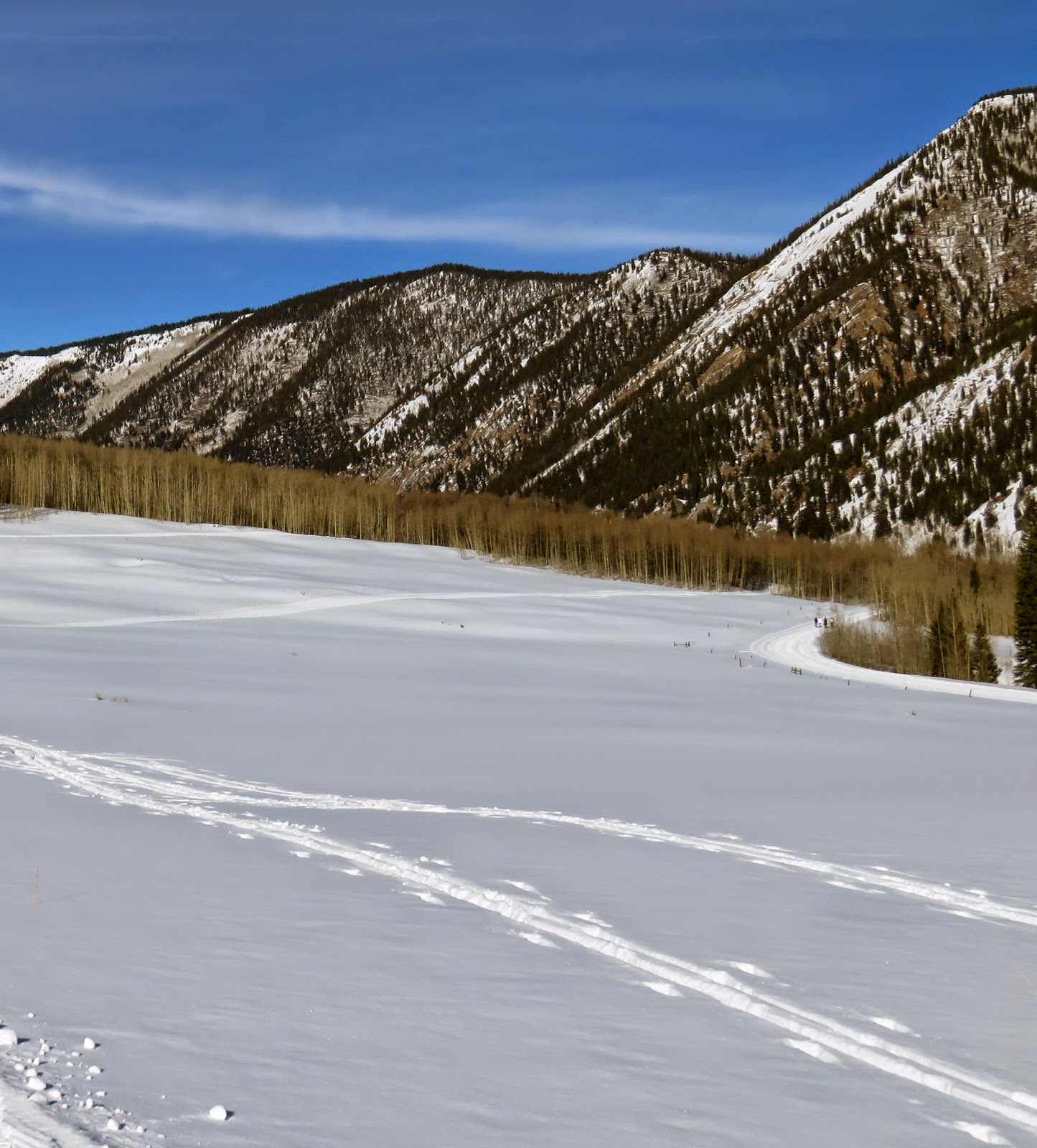 |
| H. This animal is mostly a visitor to the forest, often for recreational purposes. During winter this creature often attaches aids to its feet which make it easier to walk and glide through the snow. |
Key to the quiz:
A. Squirrel
B. Mule Deer
C. Coyote
D. Weasel
E. Elk
F. Mouse
G. Snowshoe Hare
H. Human (Cross-country skis and poles made these tracks.)
How did you do on the exam? If you're lucky enough to have snow on the ground this weekend, take a winter hike and practice your observational skills to determine which animals share the outdoor classroom where you live.
Monday, January 26, 2015
Snowshoeing the Castle Creek Valley near Aspen, Colorado
January in Aspen Colorado—the perfect venue for avid skiers, snowboarders and X-games fanatics. But, what if going downhill—fast—is not your style? What if you prefer winter recreation at a more relaxed pace? What else is there to do? Plenty, thanks to the Aspen Center for Environmental Studies, (ACES), which offers guided cross-country ski and snowshoe tours.
After our husbands left for a day on the slopes, friend Terry and I went searching for some winter fun of our own. We found it eleven miles from Aspen in the ghost town of Ashcroft.
 |
| All that's left of the once-bustling mining town of Ashcroft. |
Had you arrived in Ashcroft in 1880 you would have discovered a thriving town full of men giddy with the prospect of striking it rich in the silver mines. But, as mining towns are wont to do, the booming area went bust by 1885 and, by the early 1900s, only a handful of aging men still lived in Ashcroft. Interest in the town was restored in the 1930s with plans for a ski resort, but those plans were derailed by World War II.
Today, thankfully, both the town of Ashcroft and the Castle Creek Valley surrounding it are managed by the US Forest Service and are protected from further development. The ghost town now resides in a Spruce/Fir/Aspen forest rich with a diversity of plants and animals, surrounded by 13,000-14,000 foot peaks. The region provides countless opportunities for quiet recreation, and ACES turns those opportunities into reality by partnering with the Ashcroft Ski Touring Company, the Pine Creek Cookhouse and the White River National Forest.
 |
| The King Cabin Nordic Center—home base for winter adventure in the Castle Creek Valley. |
We meet our ACES guide at the King Cabin Nordic Center. Tawny is a recent graduate of Colorado College with a degree in Environmental Studies; she’s full of enthusiasm and ready to share her knowledge. On our hike we observe numerous animal tracks and learn how to identify them. We also gather information about the Castle Valley’s geology and ecology.
A special treat on this tour is our lunch stop at Pine Creek Cookhouse. During winter this restaurant is accessible only via a horse-drawn sleigh or a pair of hiking boots, snowshoes or cross-country skis. The food is gourmet—I enjoy a salad with cheese and nuts, topped with tender, flaky Red Trout.
 |
| Tawny describes the tracks and movement of a snowshoe hare. |
 |
| The trail crosses Castle Creek which offers reportedly good trout fishing. Worth a return visit during summer? |
 |
| A shining example of a healthy Blue Spruce in this Spruce/Fir/Aspen forest. |
A special treat on this tour is our lunch stop at Pine Creek Cookhouse. During winter this restaurant is accessible only via a horse-drawn sleigh or a pair of hiking boots, snowshoes or cross-country skis. The food is gourmet—I enjoy a salad with cheese and nuts, topped with tender, flaky Red Trout.
After lunch we return to the Nordic Center, thrilled with today’s choice of a naturalist-led snowshoe tour. Our outing included:
Exercise—a four and a half mile hike.
Education—new-found knowledge about winter in the sub-alpine zone.
Eating—a cozy interior and great food at the Pine Creek Cookhouse.
Extraordinary scenery—the snow-filled Castle Creek Valley and the high peaks of the Rocky Mountains.
Yes, we experienced all of that, and all without going downhill—fast.
 |
| A welcome rest stop on a winter day. The Pine Creek Cookhouse. |
 |
| Our hillside trail in the Ashcroft Ski Touring area. |
ACES offers educational programs as well as outdoor adventures. Find out more by visiting their website: https://www.aspennature.org
 |
| Plant your poles here, and relish the alpine ambience of the Castle Creek Valley near Aspen. |
Subscribe to:
Posts (Atom)