If the weather around you feels wintry today why not use this first day of spring to plan a get-away to someplace warmer... say Louisiana?
While touring the Pelican state several years ago I exited interstate 55 northwest of Lake Pontchartrain and found the town of Ponchatoula, Louisiana's Strawberry Capitol. Early spring is strawberry season in this part of the country and while in Louisiana’s strawberry capitol I knew what I had to do: I stopped at the Berry Patch CafĂ© for their signature dish, the strawberry beignet (pronounced ben-yay).
Wow! The famous strawberry beignet may be one of the best desserts I’ve ever had. The beignet comprises eight pieces of fried dough; a small hollow in each piece is filled with strawberry jam. The rounds of dough are accompanied by mounds of real whipped cream—not cool whip—and covered with powdered sugar. To compliment the strawberry beignet I ordered a frozen strawberry malt. The trip to Louisiana was worth it just for that slice of strawberry heaven.
Ponchatoula's annual Strawberry Festival will be held April 12-14, 2013. By describing the strawberry beignet, (and by mentioning the word "strawberry" 12 times in this post), have I tempted you to book your tickets for this mouth-watering feast? If so, visit this website: http://www.lastrawberryfestival.com/
P.S. Average temperatures in mid-April in Ponchatoula range in the 70's.
This blog showcases my fascination with travel into the heart of America. Each blog post will transport readers from behind their screens and into the realm of the American experience. My goal is to inspire people with tales of travel and discovery and to motivate them to explore the world beyond their doorsteps.
Wednesday, March 20, 2013
Wednesday, March 13, 2013
Snowshoeing the Abajo Mountains in Southeastern Utah
Mountain ranges scattered throughout the high desert of southern Utah provide an excellent opportunity for off-the-beaten-path excursions. Located near the towns of Monticello and Blanding the Abajos make up one of these ranges. A translation for the Spanish word “Abajo” is to go “up and down” and that’s what you’ll do while traveling the paved road through these highlands, which climbs up to 10,500 feet from Monticello and then down again to 7000 feet at the access road to Canyonlands National Park.
During the winter season though—in years with ample snowfall—the paved road over the summit is closed. On a January day Tim and I drove into the Abajos until our path was blocked by piles of snow. We strapped on snowshoes and left our vehicle behind while traipsing through the aspen and pine-covered hills.
| Small mountain ranges offer relief from the high desert landscapes. The town of Monticello (our starting point) is to the east of the range. Map courtesy of "greatwesterntrails.org". |
| The 32 mile drive to Blanding, on a dirt road, is a scenic byway in this national forest. It obviously wasn't open to vehicle traffic on the day we were there. |
| Aspens frame our off-the-beaten-path adventure. |
| It's sunny enough for another of our "shadow shots" on the glittering snow. |
At dusk we traveled toward the tourist mecca of Moab and were treated to a sunset/moonrise while driving north along lonely Highway 191. The setting sun cast a pink glow over the La Sal Mountains as the full moon radiated yellow/orange off the red rocks.
| Sunset highlights the LaSal Mountains on the road between Monticello and Moab. |
| A full moon rises over red rock country. |
This jaunt may have lasted only a few hours but it delivered everything a winter’s journey should: blue skies, exercise, marshmallowy snow, and a movie-quality ending.
If you’re ever in southeastern Utah and you need an escape from the desert, consider a scenic drive through the Abajo mountains. Find information by visiting this website: http://www.fs.usda.gov/recarea/mantilasal/recreation/natureviewing/recarea/?recid=73228&actid=64
Wednesday, March 6, 2013
Cross-country Skiing in Grand Teton National Park, Wyoming
The calendar says "March" but if you're interested in one last winter fling there's no better place for it than Jackson Hole and Grand Teton National Park in Wyoming.
Enter the park at Moose Junction and drive to the Taggart Lake Trailhead. From there you may choose to cross-country ski the road to Jenny Lake, or snowshoe the trail to Taggart Lake. If you choose to ski, the main road through the park is closed to vehicle traffic and is groomed for both classic and skate cross-country skiing. Another ski trail cuts through the forest along the base of the towering Tetons.
After a day in the park treat yourself to gourmet dining at Wild Sage Restaurant in the Rusty Parrot Lodge in downtown Jackson Hole. Try either the Beef Tenderloin or Crackling Salmon entrees, then finish your meal with a spirited mug of "Wyoming Coffee".
Interested in counting down the days of winter in Grand Teton National Park? Visit this website for more details: http://www.nps.gov/grte/planyourvisit/winter.htm
| Winter scene near Taggart Lake Trailhead. |
Enter the park at Moose Junction and drive to the Taggart Lake Trailhead. From there you may choose to cross-country ski the road to Jenny Lake, or snowshoe the trail to Taggart Lake. If you choose to ski, the main road through the park is closed to vehicle traffic and is groomed for both classic and skate cross-country skiing. Another ski trail cuts through the forest along the base of the towering Tetons.
| Is there a better cross-country ski venue in the entire country? |
| Trail through the forest. |
| We choose this meadow for our lunch stop. A downed log provided the perfect perch—and view—for our al fresco dining experience. |
After a day in the park treat yourself to gourmet dining at Wild Sage Restaurant in the Rusty Parrot Lodge in downtown Jackson Hole. Try either the Beef Tenderloin or Crackling Salmon entrees, then finish your meal with a spirited mug of "Wyoming Coffee".
| Winter evening on the square in downtown Jackson Hole. |
Interested in counting down the days of winter in Grand Teton National Park? Visit this website for more details: http://www.nps.gov/grte/planyourvisit/winter.htm
Thursday, February 21, 2013
North Captiva Island, Florida
It's not often I applaud the destructive force of a hurricane, but the 1921 storm which bisected Captiva Island deserves a tip of the hat for creating an island of calm in the sea of frenzied development along Florida's gulf coast.
North, (or Upper), Captiva is accessible only by air or boat. The island is a throw-back to the days before cars and highways. Electric golf carts with attached wagons transport you and your gear to a rental house. You may rent a golf cart to drive the sandy paths, and perhaps to visit one of the few restaurants or shops on North Captiva. The pounding surf and the cries of ospreys and sea birds are the only sounds you'll hear on this tranquil isle.
Search for shells, photograph birds, stroll the beach, or relax on your lanai. February or March is the right time for a Florida get-away, and a week on North Captiva Island is the ideal tonic for those wintertime blues.
North Captiva memories will sustain you for a lifetime. Plan your North Captiva idyll by visiting this website: http://www.northcaptiva.com/default.aspx?n=295377
Fort Myers is easy to fly into and is the nearest Florida city to North Captiva. Don't forget to bring your shorebird and seashell identification guides or apps.
![]() |
| If this is your idea of a relaxed beach vacation, then North Captiva is the island for you. |
North, (or Upper), Captiva is accessible only by air or boat. The island is a throw-back to the days before cars and highways. Electric golf carts with attached wagons transport you and your gear to a rental house. You may rent a golf cart to drive the sandy paths, and perhaps to visit one of the few restaurants or shops on North Captiva. The pounding surf and the cries of ospreys and sea birds are the only sounds you'll hear on this tranquil isle.
![]() |
| White Ibises search for a tasty morsel in the sand. |
![]() |
| A Snowy Egret takes off across the marsh. |
![]() |
| White Pelicans congregate by an inlet. |
Search for shells, photograph birds, stroll the beach, or relax on your lanai. February or March is the right time for a Florida get-away, and a week on North Captiva Island is the ideal tonic for those wintertime blues.
![]() |
| Colorful conch shells are found in the frothy surf. |
![]() |
| North Captiva beaches are littered with shells like these. Shells keep the island's sand in place and provide food for birds and fish. |
![]() |
| A sampling of our shell collection. Intact Sand Dollars are easy to find on North Captiva's beaches. |
North Captiva memories will sustain you for a lifetime. Plan your North Captiva idyll by visiting this website: http://www.northcaptiva.com/default.aspx?n=295377
Fort Myers is easy to fly into and is the nearest Florida city to North Captiva. Don't forget to bring your shorebird and seashell identification guides or apps.
![]() |
| Ahhh, Florida. |
Wednesday, February 13, 2013
A Valentine's Day Hike around Trout Lake in Yellowstone National Park
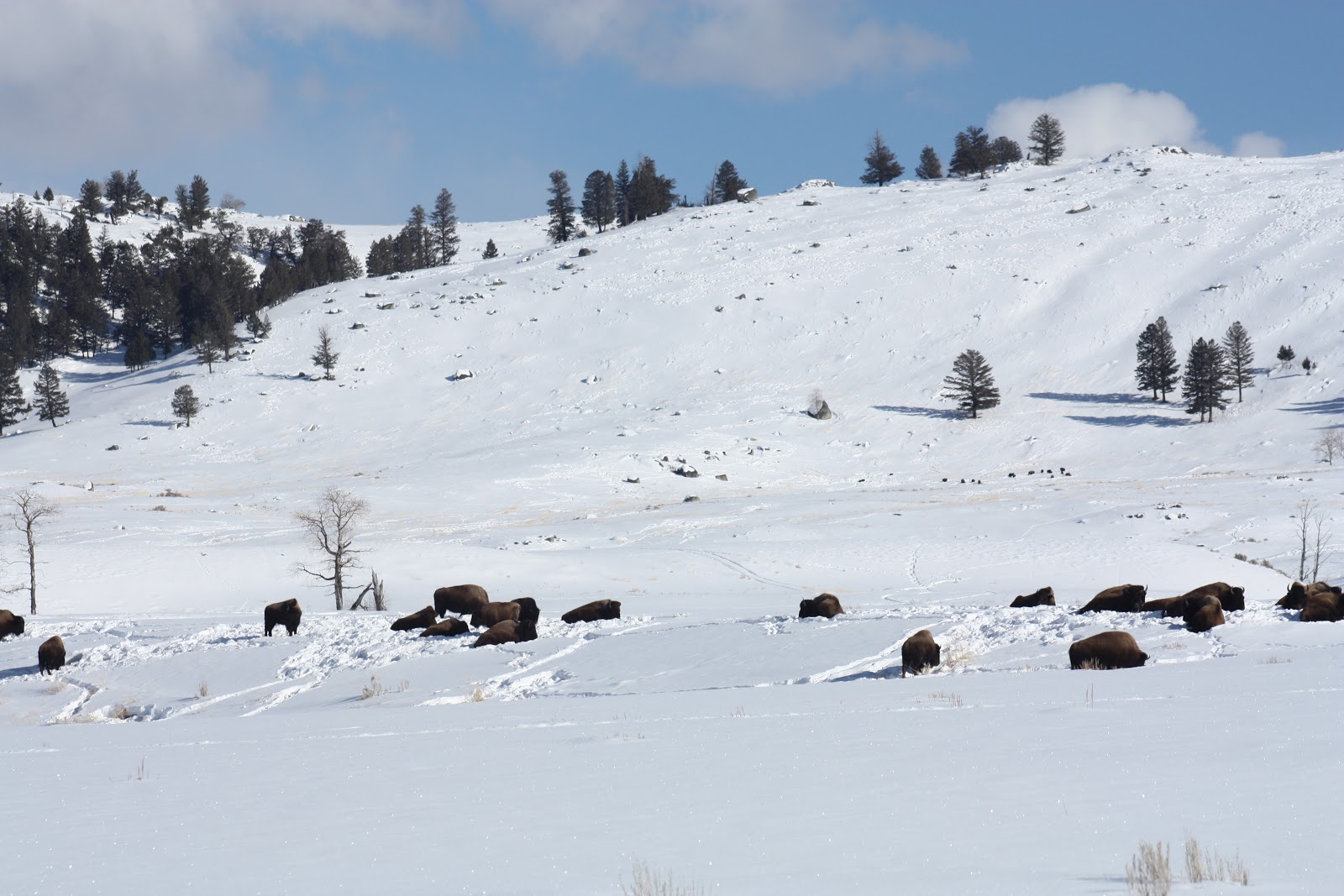
Grizzly bears—as well as hordes of people—have been reported to frequent the area around Trout Lake in Yellowstone National Park. But that's during the summer months. Visit Trout Lake for a snowshoe hike on Valentine's Day, as Tim and I did several years ago, and you won't be sharing the lake with either bears or humans.
| These bison are lounging and foraging along the road on the way to Trout Lake. No Grizzly Bears to be found in February. |
The trail ascends a steep hill into a forest of Douglas Fir trees, then breaks into the open where the lake and surrounding mountains come into view. The short one-mile "lollipop" hike loops around the lake, crosses two bridges and rejoins itself in the woods for the return to the trailhead. We completed the trail in a little over an hour and had the trees, the lake and the view all to ourselves.
| Under one of the large Douglas Fir trees along the trail. |
| Rita and Tim pose in the meadow where the trail leaves the big woods. |
| Trout Lake is in the depression to the right. The trail continues around the lake and back into the forest. |
A Valentine's Day dinner at Pedalino's Restaurant in Gardiner, Montana is a fitting way to end the perfect winter day. Pedalino's is open only one day during the winter season—February 14th. Enjoy their superb Alaskan salmon entree while reflecting on your day of solitude in Yellowstone National Park.
Trout Lake Trail is accessed from the park's north entrance in Gardiner, Montana. For a description of the Trout Lake Hike, and other hiking destinations in Yellowstone's northern section visit this website: http://www.yellowstonenationalpark.com/hikingtower.htm
Click here to read about another of our winter adventures in Yellowstone National Park.
| Time for some post-hike fun. Tim creates the "Yellowstone Snowshoe Snow Angel". (Getting back on his feet was another matter...) |
Tuesday, February 5, 2013
New Mexico's Big Sky Country
Having spent a week in New Mexico I would like to challenge Montana’s claim to the nickname "Big Sky Country". After all, New Mexico is the state where rockets were launched and the atomic bomb detonated, where missiles are tested at White Sands Missile Range, where the sun is photographed every minute of every day from the National Solar Observatory, where the Very Large Array of satellite dishes keeps an ear to the sky, where an alien spaceship is said to have landed nearly 66 years ago. Yes, there’s a lot of sky and outer space to be studied, launched into, and even visited from in our nation’s 5th largest state.
****
****
The New Mexico Museum of Space History is my first space-related stop. The four story museum’s mission is to educate visitors about the historic and scientific aspects of space and the U.S. space program. Outside the museum a collection of rockets, boosters and missiles point toward the New Mexico sky—all are actual pieces and not replicas. A Mercury space capsule at the museum’s entrance entices visitors to sit inside its cramped confines and imagine themselves as one of the first six U.S. astronauts to journey into space.
| Outdoor rocket display at The New Mexico Museum of Space History. |
| A Mercury Space Capsule—not much bigger than the astronaut who rode in it. |
****
If you had the chance to visit a town called Sunspot, would you go? I think you would. A mountainous 16 mile drive from the town of Cloudcroft in south-central New Mexico leads to Sunspot and The National Solar Observatory. Here is a place dedicated to studying the sun. During the summer researchers from all over the world make Sunspot their home.
The self-guided tour takes visitors through a spruce-pine forest to the buildings which house the sun-spying telescopes. One of them—the Tower Telescope—is 390 feet long, two-thirds of which is buried underground. Kind of like an iceberg. The long scope uses mirrors and lenses to take pictures of the sun every minute of every day. This is the place to be if you want to be in the know on the latest solar happenings.
The observatory's museum was full of fun facts about the sun, such as this one: If you harnessed the power of the sun in one lightbulb the bulb would contain 235 million, billion, billion watts–or some incredible number like that.
| Keeping an eye on the sky: The Tower Telescope. |
****
In Roswell the big draw is the International UFO Museum and Research Center. The museum documents the July 1947 crash of a UFO near Roswell and the finding of little green men (people) from the ship. The museum details reports of the crash sighting, U.S. Air Force findings and their subsequent “cover-up”. It’s all here. A research library in the museum provides further reading on the topic. The museum is entertaining, if nothing else.
Is there life on other planets? Maybe so. But I’m doubtful that the first contact with extraterrestrial life occurred here. How about you?
| What do you think? Did this really happen? |
| This exhibit shows the likenesses of the aliens discovered after the crash. |
| The UFO Museum contains a bit of humor too. |
Also in Roswell is the Roswell Art Center and Museum. The Museum showcases New Mexico artists and tells the story of Robert Goddard—Roswell’s most famous resident and the father of modern rocketry. A Robert Goddard planetarium features daily showings of all-things-rocket. This is a worthwhile stop on anyone’s trip through Roswell.
****
How about it readers? Are you convinced that New Mexico is indeed “Big Sky Country"? Perhaps Montana should cede its nickname to New Mexico’s enchanted skies.
****
Monday, January 28, 2013
Sunrise, Sunset at Bosque del Apache National Wildlife Refuge in San Antonio, New Mexico
I don’t want to move, to speak, or even to breathe—so fearful am I of altering the dawn dreamscape before my eyes. Burnt amber hues saturate the sky’s canvas. Then magenta appears, along with powder-puff blue. Finally a roiling dusky orange steals in from above and below, threatening to engulf the heavens in flames. We point our cameras skyward while the marshes at our feet reflect this celestial palette here on earth.
![]() |
| A pair of ducks float in a Kodachrome marsh. |
Where are we? Bosque del Apache National Wildlife Refuge in San Antonio, New Mexico. Tim and I have journeyed south to see the Sandhill Cranes and Snow Geese which congregate here in winter. Flocks of cranes soar overhead, their prehistoric cries lingering in the air. Clouds of geese rise as one from their nighttime watery roosts, the whirring of wings mimicking the roar of a jetliner powering up for take-off.
![]() |
![]() |
![]() |
| Top: Snow geese awaken after a good night's sleep. Middle: The geese lift off as a single organism. Bottom: The flock fans out overhead. |
The birding is rewarding but the display of color and light at dusk and dawn is astonishing.
![]() |
| No, your eyes don't deceive you. We witnessed sunrises and sunsets like these every day. |
![]() |
| Sandhill Cranes at Sunrise. |
Regular readers of this blog know I’m drawn to the natural world and I’ve gaped and gawked at many a stirring scene. But this time was different. For three days in January of 2000 Tim and I experienced sunrises and sunsets so reverent that at one point I turned to Tim and whispered: “I can’t believe I’m alive to see this.”
![]() |
| By the dawn's early light. |
![]() |
| Silhouetted Sandhills at Sunset. |
I’ve not returned to Bosque del Apache and I can’t help but wonder whether or not the birds are still abundant, the sunrises and sunsets still ablaze.
Readers, have you experienced a jaw-dropping sunrise or sunset? Where was it?
![]() |
| Birding and sky-gazing are not the only activities at Bosque del Apache. This hiking trail gives visitors a taste of southern New Mexico's desert. |
Subscribe to:
Posts (Atom)