Sunday, February 21, 2016

Sand Creek Massacre National Historic Site, Colorado


Cheyenne and Arapaho still return here to pay tribute to
ancestors who both perished and survived the 1864 massacre.


          Many of our national parks inspire awe, motivating visitors to look outward and be wowed by scenic splendor.  Sand Creek Massacre National Historic Site, established in April of 2007, is not one of those parks.  It asks the visitor to look inward and contemplate man’s inhumanity to man, to absorb the silence and reflect on the lessons to be learned there. 

                                                                            ****

          A great American tragedy occurred in late November of 1864.  This tragedy is part of our history, but it's not one we schoolchildren learned while studying the European conquest of North America. 

          During the early 1800s the US government signed treaties with Indian nations promising them much of the land on the Great Plains in exchange for safe passage for whites.  After the discovery of gold and other valuable minerals in the area, those treaties were no longer considered convenient (read, profitable). So Colorado Territorial Governor John Evans proclaimed that a new policy take effect in 1864, its mission “... to kill and destroy, as enemies of the country, wherever they may be found, all such hostile Indians”.

          United States volunteer cavalry soldiers such as Colonel John Chivington took that message to heart, and to mean “all Indians, hostile or otherwise”.  On November 28, 1864 Colonel Chivington led a surprise attack on the peaceful Indian settlement of predominately women and children camped at Sand Creek. 


          Two captains with the US Volunteer Cavalry, Joseph Cramer and Silas Soule, refused to take part in the massacre and had their regiments stand down, all the while witnessing this horrific tragedy.  The passage below is taken from letters detailing the eye-witness accounts of captains Cramer and Soule.

“The massacre lasted six or eight hours.  I tell you it was hard to see little children on their knees have their brains beat out by men professing to be civilized.  One squaw was wounded and a fellow took a hatchet to finish her, she held her arms up to defend her, and he cut one arm off and held the other with one hand and dashed the hatchet through her brain.  Some tried to escape on the prairie, but most of them were run down by horsemen.  They were all scalped, and as high as half a dozen taken from one head.  They were all horribly mutilated.  One woman was cut open and a child taken out of her, and scalped.”
                                                                                                           --Captain Silas Soule

          After the massacre soldiers paraded the streets of Denver holding body parts in their hands, cheered on by some in the crowd.

          If not for the bravery of Captains Soule and Cramer, the acts described above may have continued unabated.  As it was, these accounts of the massacre led to congressional hearings in 1865 and a new method of dealing with the “Indian problem” was launched.  From this point on our government’s old policy of extermination was replaced by a new policy of assimilation.  This assimilation attempt would be only partially "successful", due to the resilience of the Cheyenne and Arapaho people.

                                                                              ****

          I should mention that Colonel Chivington has his apologists as does Governor Evans.  I’ve read that the US Cavalry was only doing onto the Indians what was done onto them, that Captains Soule and Cramer had hidden agendas when they wrote their damning accounts of this massacre.  And we’ve all heard this argument:  “All was not peace and love on native lands, you know.  Tribes continually warred with one another.”

          Well, yes.  Humans are a warring species. 

          But, no.  The “everybody’s doing it” excuse CAN NOT justify what happened here. 

          See for yourself.  Travel to Sand Creek, near the town of Chivington—named in "honor" of the savage colonel—in southeastern Colorado.   

          Visit the high plains site where the massacre occurred.  Listen as the breeze rustles the thistles and grasses.  View the meadow below the escarpment, the willowy trees lining the banks of what once was a small stream.  Imagine the camp there, the place where several hundred women, children and retired warriors were promised safe haven by Colorado territory officials.  Remember the atrocities which occurred there, atrocities for which Colonel Chivington and his men were never held accountable.   Then, take heed as the park’s rangers remind you that this place was established with the belief that we’re a better people now, that what happened here could never happen again.


          I would like to believe that too.

Meadow below the escarpment; site of the 1864 Cheyenne and Arapaho
temporary settlement.


Colonel Chivington has a town named for him.
In 1895 the Colorado state legislature re-named a prominent Colorado
mountain peak in honor of the esteemed and murderous Governor Evans.

The least we could do for Cheyenne Chief White Antelope—who raised the white
surrender flag when the US Cavalry approached Sand Creek and who
was mutilated and killed in the attack—was to name this dirt road after him.


Wednesday, January 27, 2016

Snowshoeing Nellie Creek and Cinnamon Pass Roads near Lake City, Colorado

         Checklist of requirements for winter fun:

         1)   A reliable vehicle:
               √ Our Toyota FJ fits the bill.

         2)   Snowshoes:
               √ Atlas snowshoes with their easy in-and-out bindings work on all types and depths
               of snow.

         3)   A snow-loving dog:
               √ Annie the winter wonder dog is always ready to go.

         4)   Access to the San Juan Mountains of southwestern Colorado:
               √  From our Lake City cabin it's a short drive to endless alpine terrain.

         Our checklist complete, it's time to select snowshoeing destinations.
         First stop, Nellie Creek Road, west of town along the Alpine Loop backcountry byway.  During summer and fall Nellie Creek Road serves as the gateway to Uncompaghre Peak and surrounding wilderness areas.  The rugged four-wheel drive road is closed to vehicles during winter and the aspen-lined lane is perfect for snowshoes.
         Second stop, Cinnamon Pass Road, south of Lake City past Lake San Cristobal.   On its way to the 12,640' summit, Cinnamon Pass Road cuts through steep hillsides and offers jaw-dropping mountain views.

         Let the snowshoe adventures begin!

Winter fun criteria are met:
Toyota FJ Cruiser (center); Mountains (surrounding the FJ);
Snowshoes (to the right of vehicle); Dog (Annie in the foreground).


         First, Nellie Creek Road:

Annie loves digging into, and romping in, the snow.


Rita composes a photo while Annie looks on.


Tim and Annie round a corner on the return to the trailhead.


Bright white aspens.  Bright blue sky.  What's not to like?


Aspens, and one perfect-sized Christmas tree,
line Nellie Creek Road.

         Next, the glorious Cinnamon Pass Road:

Hazards of mountain travel.  Freeze-thaw cycles can create pressure in the rock walls,
causing boulders to fall.   You hope this does NOT happen while you're there.

Annie runs back to greet me while Tim treks onward and upward
on Cinnamon Pass Road.

The turn-around spot.
Notice the untracked snow behind us.


Tuesday, November 17, 2015

Tribute to a Traveler: Robert Wechter 1928 - 2015

         Two weeks before being diagnosed with colon cancer, my father sat on the porch of our beach rental house and leafed through the latest issue of National Geographic Traveler.  Forever in search of another adventure Dad awaited the Traveler each month, devouring it from cover to cover.

         After Dad set the magazine aside I asked the question he had come to expect every summer:  "How about a list of places you and Mom would like to see in 2016?"  Although my parents still reminisced and recalled special moments from previous international journeys, lately they'd limited their travel destinations to North America.
         Dad thought for a moment.  "Well, let's see," he said,  "I've never been to Montana.  Then there's the Columbia River Gorge.  The Florida Keys would be nice.  Or, how about Nova Scotia?"  Now Mom chimed in:  "Oh yes, " she added, "I've always wanted to see Nova Scotia."

         At ages 86 and 85 Dad and Mom didn't get around as well as they used to.   And even though Dad hadn't been feeling quite himself lately, we had recently returned from a trip to South Carolina, Georgia and Florida.  As for Canada, their passports were current; they were ready to go!

       That settled it.  "Come January," I said,  "I'll start the Nova Scotia trip-planning."

       Cancer, however, had other plans.  Cruel, heartless, unforgiving plans.
       Less than three months later, on a bright blue October day, Dad was gone.

                                                                      ****

       Dad was a fan of my blog and eagerly awaited each new post.  He and Mom had never bought a computer so I printed the blogs and mailed them copies.  Dad always commented on my posts but my readers never saw his reviews online; he commented the old-fashioned way—over the telephone.
       I will miss that.

                                                                      ****

       I suppose it's the ultimate tribute to say of someone that at the age of eighty-six he was "gone too soon".   But my Dad still had enthusiasm for life and for travel.  He had places to go and things to do!  Below are some photos from the past several years of travel with my parents.  Gone too soon.  Indeed.


July 2015.  Surrey-riding on the boardwalk at Ocean City, New Jersey.


 March, 2015.  A lifelong baseball fan, Dad was thrilled to watch
 grandson Mark play Division One College Baseball
for Winthrop University.  Here he poses with
me,  Mark and my sister, Diane, after a Winthrop win in South Carolina.


March 2015.  Enjoying the sight of thousands of blooming
azaleas at Wesley Memorial Gardens, St. Simon's Island, Georgia.


December 2013.  Not just fair-weather travelers!   My parents toughed out
a zero degree day in Jackson Hole and the Grand Tetons.


June 2014.   Dad always looked forward to sampling the
regional cuisine of the places he traveled to.  At Doc Martin's
Restaurant in Taos, New Mexico we savor an
authentic southwestern meal. 


June 2014.  Ready to roll.  Relaxing at the Old Santa Fe Inn before
traveling to the next New Mexico destination.


June 2014.  Ah, the good life.  Taking a break at the
Adobe and Pines Inn,  Taos, New Mexico.


Sunday, August 2, 2015

Once in a Blue Moon

          We missed it—missed that moment when the moon crests the ridge and appears as a giant glowing beach ball ready to bounce its way down the hillside and into our picnic site.  By the time we reach the overlook with our cameras the blue moon has cleared the peaks, receded from our grasp, shrunk into the vast night sky.

 A few minutes before snapping this photo the moon was perched
atop the mountain,  twice as large and seemingly within reach.

          The Blue Moon—the second full moon occurring in the same calendar month—is rarely blue but always compelling.  And worth the 20 mile trip to Price Canyon Recreation Area to witness this spectacle which won't recur until January 31, 2018.

The sky darkens, and features of the moon sharpen.


July 31, 2015


          Read a lyrical account of last Friday's blue moon by Soumyendu on his wonderful blog, Ramblings:
http://manikchand-ramblings.blogspot.com/2015/08/blue-moon.html


Monday, July 13, 2015

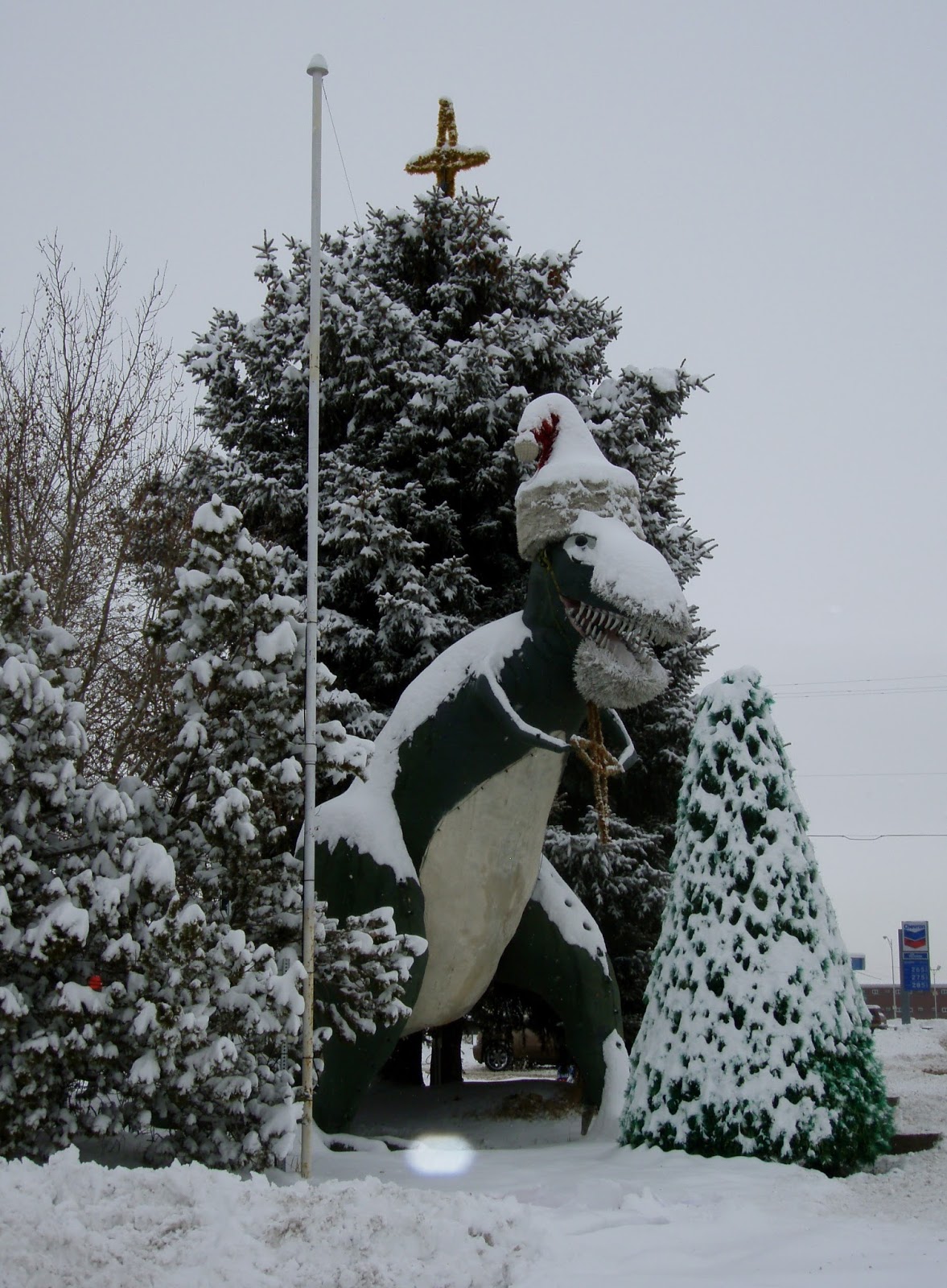
A Year with "Dino", the Vernal, Utah Dinosaur

         What fun to have a dinosaur to dress for different seasons and holidays!

         Tim and I drive through the town of Vernal every month, and each month we look forward to viewing "Dino" in his seasonal attire and adornments.

          Last week I introduced readers to "Dino", the unofficial mascot of Vernal.  In this post I present a photo essay of "Dino" as he is displayed throughout the year.  Enjoy!

January-February
Dino plays cupid for love-struck passers-by.


March
Dino honors the legendary Dr. Suess's birthday
on March 2nd, with this tribute to his books.


March-April
Happy Easter!

May
Dino holds a sign with a photo of himself as a hatchling,
and a touching shout-out to Mom which reads:
"Mommy You're The Best!".


June
Here's to the class of 2015!


July
Happy Birthday, America!

July-August
The fishing is good at nearby Jones Hole Creek,
part of Dinosaur National Monument.


August-September
The top photo shows Dino enjoying a cookout,
along with the garden's late-summer bounty of watermelon
and pumpkin.
In the bottom photo Dino is all aglow for nighttime.

October.
A large and furry spider spins its web around Dino,
and he doesn't even seem to care!


November
Dino is ready to take the turkey out of the oven.

December
Merry Christmas from Santa Dino!


Friday, July 3, 2015

Happy 239th Birthday, USA!

             Tomorrow, July 4, 2015, Americans everywhere will be celebrating Independence Day with picnics, parades and pyrotechnics.  Have a Happy Holiday!


Main Street USA.
Vernal, Utah is the gateway city to Dinosaur National Monument.
One of Vernal's unofficial mascots,  "Dino" the dinosaur, is dressed for holiday fun.


Tuesday, May 19, 2015

Sand Wash Herd Management Area in Moffat County, Colorado

          "Did you see Picasso?"  The question comes from a portly middle-aged man sporting a long-lens camera around his neck.  Unsure exactly what he's asking Tim and I answer with a short "Uh, no," and move on.

           Reflecting on his question later I realized that today we have seen irregular patterns of black and brown, a not-quite-pink combination of cream and beige, black mixed with roan to create a speckled blue.  I refer though, not to paintings by famous artists, but to wild horses.

           Native wild horses disappeared from North America thousands of years ago.  The horses we're viewing today are descendants of horses which escaped during the Spanish conquest of our continent in the 1500s.  The controversy surrounding wild horses is this:  Are they truly wild, or are they an invasive species?  Biologists tell us that domesticated horses revert quickly to their ancient behavioral patterns if lost or abandoned.  Considering that these horses have been roaming free on the land for 500 years, I would say they're more native than I am.

Several of the horses we saw while driving
the "Wild Horse Loop" displayed a healthy
interest in us.  This horse watched us for
several minutes before slowly turning away.

This small group of wild horses grazes the sage-covered high plains of
northwestern Colorado.

We were fortunate to encounter this little filly and her mother
by the side of the road.

           Human settlements in the west—and endless miles of fencing—are now the biggest obstacles to free-ranging wild horses.  Even in sparsely populated Moffat County, Colorado the wild herd is managed by the Bureau of Land Management to keep their numbers from overwhelming the designated habitat.  But, fortunately for these horses, the 156,500 acres of the herd management area in Sand Wash Basin sustains a healthy population.  And that population is filled with animals sporting every possible color combination.

          Now we get it.  The gentleman with the camera was asking about a horse named "Picasso",  most likely one exhibiting Picasso-esque colors.   So did we see him?  A Google search reveals multiple photos of the famed wild stallion and our question is answered.

Picasso (the painter) used shades of brown and black
in his "cubist" paintings.  You can see how this wild stallion
got his name.
Photo by John Wagner, from the website:
nwcoloradoheritagetravel.org 

          No, we didn't see "Picasso" this day in the basin.  But it was an excellent day on the range, in the company of wild horses.


This mare trotted by the truck, her snorts and
whinnies singing to the sky as she passed by.

Lookout Mountain (straight ahead in center of photo)
defines the northern boundary of the Sand Wash Herd
Management Area.

"Mom" and her baby share a tender moment on the ridge.

            Plan your wild horse-viewing get-away in the wild country of northwestern Colorado by visiting this website:http://www.blm.gov/co/st/en/fo/lsfo/programs/wild_horse.html
Note:  This is a remote and rugged region with the nearest services (limited) 25-30 miles away.  Be prepared when traveling in this area.

Our truck is a mere blip on the landscape.
We saw one other person (mentioned above) during
our three hours in Sand Wash Basin.

The dark green line delineates the Wild Horse Management Area.
The dark red lines are the County roads of the Wild Horse Loop.
We saw groupings of horses along each of the loops.